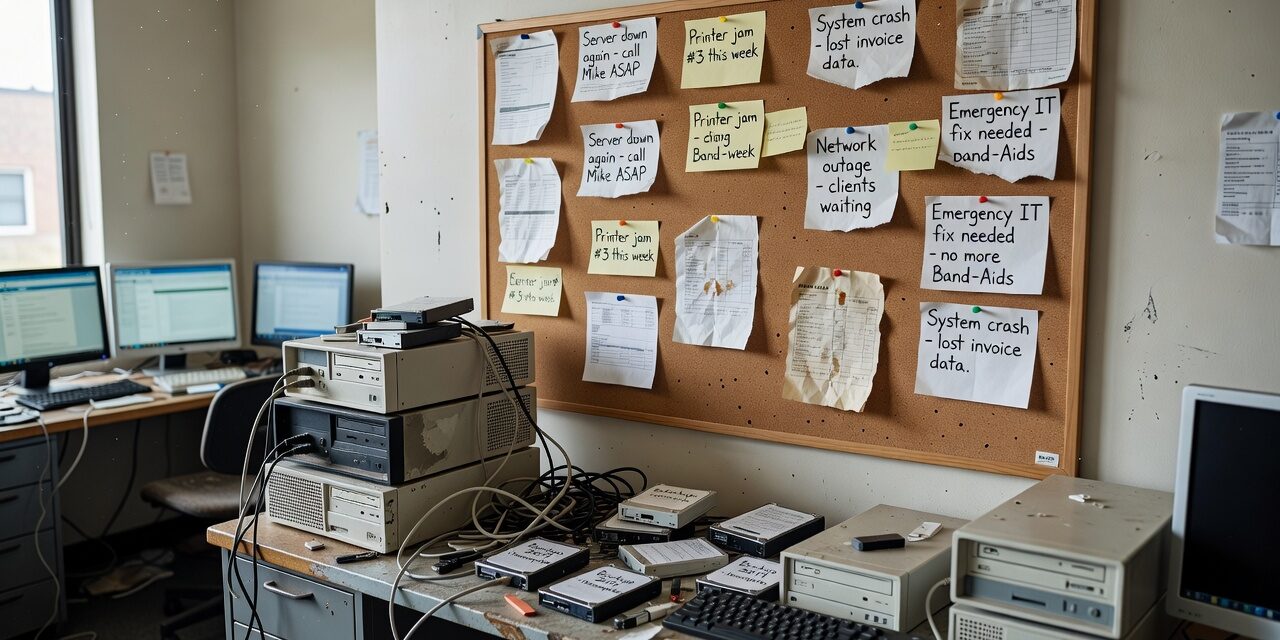
There’s a point in most growing businesses where the old approach to IT stops working quietly and starts failing loudly. If your team is calling the same person every time something breaks, waiting hours for a fix, and hoping nothing goes wrong during your busiest week of the year — those aren’t just inconveniences. They’re signs your business has outgrown break-fix IT support.
Break-fix is exactly what it sounds like: something breaks, you call someone, they fix it, you pay. It works fine when your technology is simple and your staff is small. But as your headcount grows, your reliance on cloud apps deepens, and the cost of downtime increases, that model carries real risk.
What Break-Fix Support Actually Costs You
The most obvious cost is the hourly rate. But that’s rarely the biggest number.
When a break-fix technician shows up — or dials in — the problem has usually already been affecting your team for a while. Maybe your VoIP phones went down at 9 a.m. and the tech wasn’t available until noon. That’s three hours of staff working around a problem, supervisors troubleshooting on their own, and customers potentially getting a busy signal.
Recurring problems are the clearest sign the model isn’t working. If your team has called about the same slow network, the same Microsoft 365 login errors, or the same printer connectivity issue more than twice, that’s not bad luck. It’s a support structure that fixes symptoms without addressing causes.
One common scenario: an office manager at a 40-person company keeps submitting tickets for staff who can’t access shared files in OneDrive. Each fix takes 20 minutes. But because no one is managing the underlying Microsoft 365 configuration, the issue comes back every few weeks. Over a year, that’s dozens of hours of lost productivity — and a frustrated team that starts working around the problem in ways that create new risks.
Operational Signs You’ve Hit the Limit
Break-fix support doesn’t give you visibility. You only know something is wrong when someone tells you. That gap creates a few predictable failure patterns.
You don’t have a backup you’ve actually tested. Many businesses assume their data is backed up because they set something up two years ago. But if no one is monitoring those backups, a failure can go undetected for weeks. You won’t know until you need to restore — and that’s the worst time to find out.
Your IT vendor doesn’t know your environment. A break-fix provider who shows up every few months has no institutional knowledge of your network, your software stack, or how your team actually works. Every visit starts from scratch, which slows down the fix and increases the chance of introducing new problems.
You have no one watching for security issues. Phishing attempts, failed login alerts, unusual file access — none of these trigger a phone call under a break-fix model. They only become visible after something goes wrong. For a company handling sensitive client data or running on cloud applications, that’s a significant exposure.
Office changes catch you off guard. A new hire, a new location, a shift to hybrid work — each of these creates IT decisions that need to be made proactively. Without someone managing your environment on an ongoing basis, these transitions tend to be reactive and messy. A business that opened a second location without proper network planning, for example, often finds that staff at the new office deal with persistent slowness on cloud apps and video calls for months before anyone addresses the root cause.
The Common Mistake: Mistaking Low Bills for Low Cost
Break-fix feels affordable because you only pay when something happens. That makes it easy to rationalize — especially if your monthly bills look manageable.
But what that math misses is the cost of the time your staff loses, the decisions that don’t get made because no one is advising you, and the risks that accumulate silently. Security gaps don’t send invoices. Backup failures don’t show up in your accounts payable until it’s too late.
Many growing businesses stick with break-fix longer than they should because the individual incidents don’t feel catastrophic. It’s the accumulation that catches up with them — a string of small disruptions that quietly erode productivity, morale, and eventually customer experience.
There’s also a dependency risk that’s easy to overlook. If your IT support is one person — a freelancer, a family connection, or a part-time tech — and that person becomes unavailable, your entire IT function is on hold. That’s not a resilient model for a business with 30, 50, or 100 employees depending on their systems every day.
Practical Decision-Making Guidance: When to Make the Switch
You don’t need to be in crisis to recognize when a change makes sense. A few practical indicators:
- Your headcount has grown past 15 to 20 employees and IT issues now affect multiple people at once
- You’re running cloud applications, VoIP, or remote access that require consistent configuration and monitoring
- You’ve had two or more significant disruptions in the past six months — even if each one was eventually resolved
- You’re planning a move, a new location, or a major hiring push and have no IT roadmap to support it
- You’re in a regulated industry or handle client data that requires documented security practices
If two or more of these apply, the break-fix model is likely already costing you more than you realize. Exploring managed IT support for growing businesses is worth a direct conversation — not because it’s always the right answer, but because the comparison is usually clarifying.
What This Means for Your Business
Break-fix IT isn’t a bad product — it’s a model designed for a different size and complexity of business. The challenge is that most businesses don’t notice they’ve outgrown it until something significant goes wrong.
If your team is dealing with recurring issues, your backups haven’t been tested, you’re growing headcount, or you’re planning any kind of infrastructure change, it’s worth taking a clear-eyed look at whether your current IT support model is keeping pace.
TECHZN works with businesses in Dallas and Austin that are at exactly this inflection point — past the break-fix stage, ready for something more structured. If you’d like to talk through what that would look like for your team, reach out to TECHZN for a straightforward conversation — no pressure, no pitch deck.