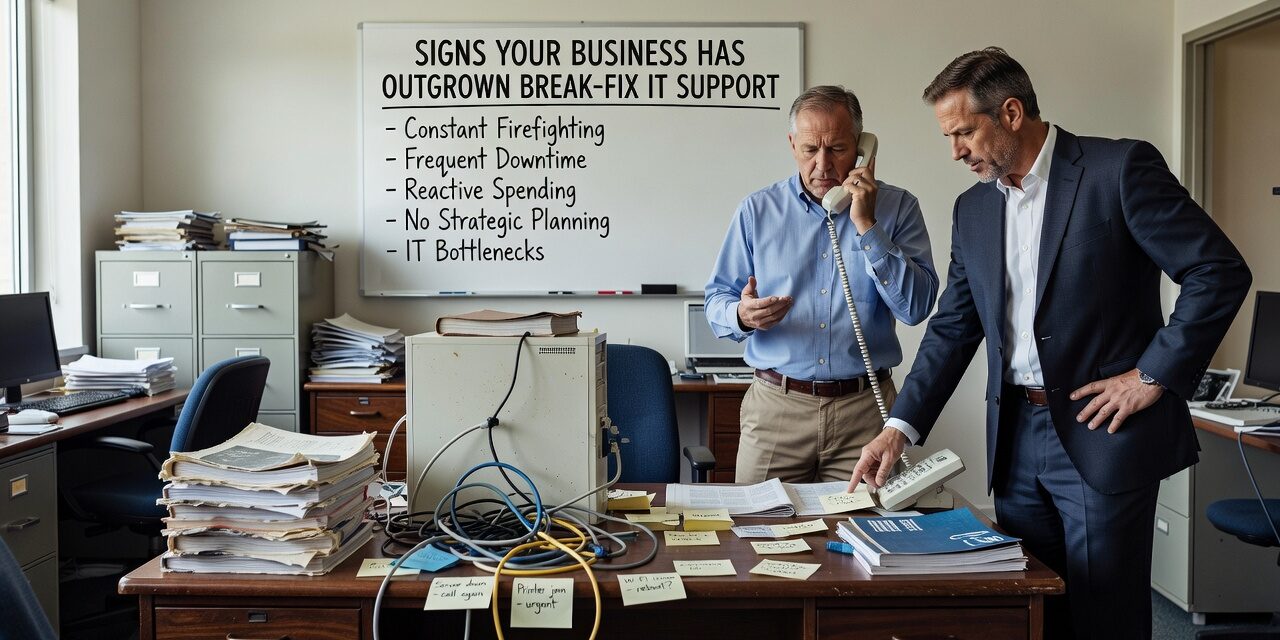
At some point, the way you’ve been handling IT stops working. Not all at once—it happens gradually. A slow fix here, a recurring problem there, a frustrated employee who’s been waiting two days for a response. If any of that sounds familiar, it’s worth asking whether your current IT support model is actually built for where your business is now—not where it was three years ago.
Break-fix support made sense when you had five employees and a simple setup. You called someone when something broke, they fixed it, and life moved on. But as your team grows, your systems get more complex, and your dependence on technology increases, that reactive model starts creating real operational problems. These are the clearest signs your business has outgrown break-fix IT support.
Your IT Problems Keep Coming Back
One of the most reliable indicators is recurring issues. If your team is opening the same type of help desk ticket every few weeks—slow internet, Microsoft 365 login problems, printer failures, email delays—those aren’t isolated incidents. They’re symptoms of something that was never fully diagnosed or fixed.
Break-fix providers patch the immediate problem and move on. There’s no incentive to find the root cause, because finding it would reduce future billable calls. A business with a reactive IT model often ends up paying repeatedly to fix the same thing, without ever actually resolving it.
This is particularly common with network issues. A small office might experience intermittent slowdowns, get a quick fix, and assume the problem is gone—until it happens again during a busy period and takes down a critical system for several hours.
You Can’t Get a Straight Answer When Something Goes Wrong
When a server goes down or a key application stops working, how long does it take you to get someone on the phone? How long before someone is actually working on it? And when they are working on it, do you know what’s happening—or are you just waiting and hoping?
Response time and communication are where break-fix models most visibly fall apart. There’s typically no service level agreement, no defined priority queue, and no guaranteed resolution window. Your issue goes into a general queue, and you get to it when you get to it.
For businesses that rely on technology to serve customers, process orders, or run day-to-day operations, that ambiguity is a real business risk. A four-hour wait to restore access to a shared file system or a cloud application isn’t just inconvenient—it’s lost productivity across your entire team.
If your staff has learned to work around IT problems rather than report them, that’s a sign the current support model isn’t meeting basic expectations.
You’re Managing Multiple IT Vendors With No One Coordinating Them
This is a common blind spot. Over time, many growing businesses accumulate a collection of IT relationships—one vendor for internet, another for phones, someone else for software licensing, and a break-fix technician who handles the rest. When something breaks that involves more than one of these vendors, no one takes ownership.
Consider a business that moves to a new office location. The internet provider says the connection is fine. The phone vendor says their system is working. But staff can’t make calls and can’t access cloud applications reliably. With no single IT partner coordinating the troubleshooting, the business spends days going back and forth between vendors while the problem persists.
Vendor fragmentation is one of the most underappreciated sources of downtime in small and midsize businesses. When you have a managed IT partner who owns the full picture, that kind of finger-pointing doesn’t happen—because there’s one accountable party.
You Have No Visibility Into What Could Go Wrong Next
Break-fix IT is entirely backward-looking. It responds to what already happened. There’s no monitoring, no planning, no one watching your systems for early warning signs.
Here’s a practical example: backups. Many businesses assume their data is being backed up because someone set it up years ago. A break-fix provider isn’t checking whether those backups are completing successfully or whether the backup destination is running out of space. The first sign of a problem is often a failed restore attempt after an incident—which is exactly the worst moment to find out your backups haven’t been working.
If you can’t answer basic questions—like when your server was last patched, whether your backups were tested recently, or how long it would take to get your systems back online after a hardware failure—your current IT model isn’t giving you the visibility you need to make sound operational decisions.
Your IT Support Can’t Keep Up With Your Growth Plans
Adding employees, opening a new office, adopting new software, moving to the cloud—each of these creates IT complexity. Break-fix support isn’t structured to grow with you. It doesn’t include planning, documentation, or a technology roadmap. It shows up when things break.
If you’re planning meaningful growth over the next 12 to 24 months, it’s worth asking whether your current IT model can support that trajectory. Can your IT provider help you evaluate new software before you commit to it? Will they handle the setup and coordination for a new office location? Do they know enough about your environment to make recommendations proactively?
For growing teams in Texas, managed IT support for growing businesses typically includes exactly this kind of forward-looking support—regular reviews, documented systems, and a provider who understands your business goals, not just your current hardware.
What This Means for Your Business
Break-fix IT isn’t inherently bad—it can work fine for very small, simple setups with minimal technology dependence. But if your business has grown past that point, the cost of staying reactive tends to exceed the cost of moving to a structured support model. Downtime gets more expensive, recurring problems drain staff time, and the lack of planning creates risk that compounds over time.
The goal isn’t to have less IT involvement—it’s to have IT support that actually matches the scale and complexity of your operations.
If you’re seeing these signs in your own business, TECHZN works with companies across Dallas and Austin to evaluate their current IT setup and build a support model that actually fits how they work. Reach out to start a straightforward conversation about what better IT support could look like for your team.