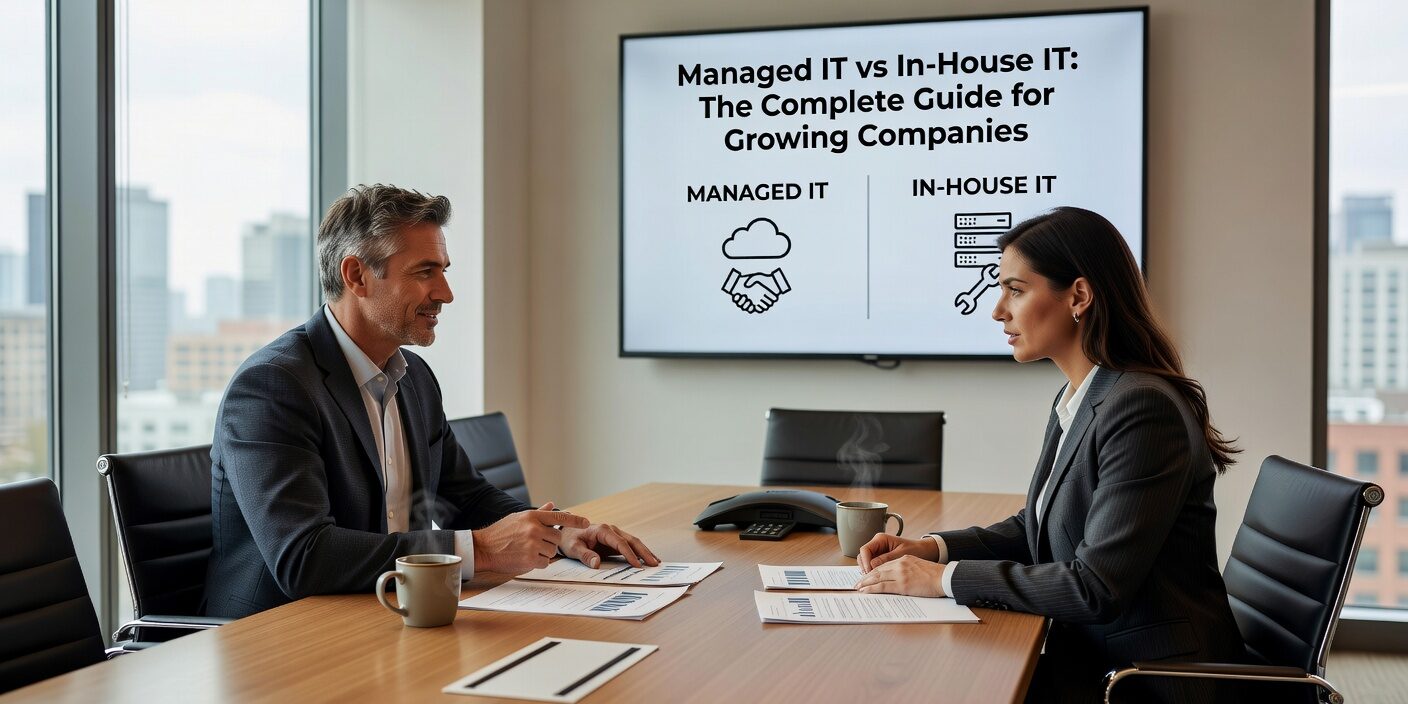
As your business grows, you’ll face a critical decision that affects everything from daily productivity to long-term scalability: should you build an internal IT department or partner with an external provider? The choice between managed IT services vs in-house IT isn’t just about cost—it’s about finding the right balance of expertise, reliability, and strategic support for your company’s specific needs.
Most growing companies start with basic IT support, but as you add employees, locations, and technology requirements, your original approach may no longer serve you well. Understanding when and how to evolve your IT strategy can prevent costly mistakes and position your business for sustainable growth.
Understanding Your IT Options
Before diving into the comparison, it’s helpful to clarify what each approach actually involves.
In-House IT
Building an internal IT team means hiring full-time employees to handle your technology needs. This typically includes:
- Help desk support for daily user issues
- System administration and maintenance
- Security monitoring and incident response
- Project management for technology initiatives
- Vendor relationship management
For small companies, this might mean one “IT person” wearing multiple hats. Larger organizations often need specialized roles covering networking, security, cloud services, and user support.
Managed IT Services
Partnering with a managed service provider means outsourcing some or all IT functions to an external team. Services typically include:
- 24/7 monitoring and support
- Proactive maintenance and updates
- Security management and threat response
- Help desk support for your users
- Strategic planning and project management
- Backup and disaster recovery
Many providers offer flexible arrangements, from full outsourcing to co-managed models that supplement your existing team.
Cost Considerations: Beyond Salary Numbers
When evaluating costs, look beyond basic salary figures to understand the true financial impact of each approach.
Hidden Costs of In-House IT
Building an internal team involves more than hiring salaries:
- Benefits and payroll taxes (typically 25-30% above base salary)
- Office space, equipment, and software licenses
- Recruiting and onboarding costs
- Training and certification expenses
- Turnover replacement costs when team members leave
- Overtime or contractor costs for after-hours coverage
- Additional hires for specialized projects
For most growing companies, these hidden costs add up quickly. A single IT professional earning $70,000 annually might actually cost your business $95,000 when you factor in benefits, training, and infrastructure.
Managed IT Pricing Structure
Managed service providers typically use predictable monthly pricing that bundles:
- Multiple skill sets and expertise areas
- 24/7 monitoring and support coverage
- Security tools and threat monitoring
- Regular maintenance and updates
- Project support and strategic planning
This model often provides better cost predictability and access to broader expertise at a lower total cost than building equivalent capabilities internally.
Staffing Challenges and Risk Management
Growing companies face unique staffing challenges that can make or break their IT strategy.
The “Key Person” Risk
Many small businesses rely on one or two IT professionals who become indispensable. This creates several problems:
- Knowledge concentration: Critical information exists in one person’s head
- Coverage gaps: Limited backup when someone is sick, on vacation, or leaves
- Skill limitations: No single person can be expert in every technology area
- Burnout potential: Overwhelming workload leads to mistakes and turnover
As your business grows, this approach becomes increasingly risky and unsustainable.
Professional Development and Retention
Keeping skilled IT professionals engaged requires:
- Competitive salaries that increase with market rates
- Ongoing training and certification opportunities
- Career advancement paths
- Modern tools and interesting projects
Many growing companies struggle to provide these elements, leading to turnover at critical moments.
Expertise and Capabilities Comparison
Modern business IT requires expertise across multiple specialized areas that can be difficult to build internally.
Depth vs. Breadth Challenge
A typical growing business needs support in:
- User support and help desk services
- Network design and maintenance
- Cybersecurity monitoring and response
- Cloud platform management
- Backup and disaster recovery
- Compliance and risk management
- Strategic technology planning
Building deep expertise in all these areas requires either hiring multiple specialists (expensive) or accepting capability gaps (risky).
How Managed IT Addresses Expertise Gaps
Established managed service providers typically offer:
- Team-based expertise covering all major technology areas
- Regular training and certification maintenance
- Experience across many client environments
- Access to enterprise-grade tools and platforms
- Established incident response procedures
This breadth of capability is particularly valuable for cybersecurity, where threats evolve rapidly and specialized knowledge makes a significant difference.
Scalability for Growing Companies
Challenges of Scaling In-House IT
As your business grows, internal IT teams face several scaling challenges:
- Hiring lag time: Finding and onboarding new team members takes months
- Capacity planning: Difficult to predict exact staffing needs
- Geographic expansion: Supporting multiple locations requires local presence or travel
- Seasonal fluctuations: Hard to adjust team size for temporary needs
Managed IT Scalability Advantages
External providers are designed for flexible scaling:
- Rapid user additions without hiring delays
- Multi-location support through existing infrastructure
- Seasonal adjustments through service level changes
- Project-based scaling for major initiatives
This flexibility is particularly valuable during periods of rapid growth, acquisition, or seasonal demand changes.
Control and Customization Factors
When In-House Makes Sense
Some situations favor internal IT teams:
- Highly specialized systems requiring deep, custom knowledge
- Strict regulatory requirements demanding maximum control
- Proprietary technology that external providers can’t support
- Strategic IT initiatives central to business differentiation
- Large, stable organizations with consistent IT needs
When Managed IT Works Better
Most growing companies benefit from external expertise when:
- Using standard business applications (Microsoft 365, CRM, accounting software)
- Focusing leadership attention on core business growth rather than IT management
- Needing rapid access to new technologies or capabilities
- Operating in competitive markets where IT efficiency provides advantage
- Managing multiple locations or remote teams
Making the Right Decision for Your Business
Consider these key questions when evaluating your IT approach:
Budget and Growth Planning
- Can you afford multiple full-time IT salaries plus benefits and tools?
- Do you have predictable IT spending needs, or do costs vary significantly?
- How important is budget predictability for your financial planning?
Risk Tolerance
- What happens to your business if your IT person leaves suddenly?
- How critical is 24/7 IT availability for your operations?
- Can you afford significant downtime during staff transitions?
Strategic Focus
- Is IT management a core competency you want to develop internally?
- Would you prefer to focus management attention on other business areas?
- Do you need maximum customization, or are standard solutions acceptable?
Growth Trajectory
- Are you planning significant expansion in the next 2-3 years?
- Will you be adding new locations or remote workers?
- Do you anticipate major technology projects or migrations?
What This Means for Your Business
The choice between managed IT services vs in-house IT isn’t about finding a universal “best” option—it’s about matching your IT strategy to your business reality. Most successful growing companies find that external partnerships provide better risk management, broader expertise, and more predictable costs than trying to build everything internally.
The key is honest assessment of your current situation and future needs. If you’re relying on one or two key people, struggling with after-hours coverage, or finding that technology projects get delayed by daily support demands, it may be time to explore how managed IT services could provide the reliability, expertise, and scalability your growing business needs.
A well-planned IT strategy—whether internal, external, or hybrid—gives you the foundation for sustainable growth, better security, and the operational efficiency that lets you focus on what you do best.
Ready to Evaluate Your IT Strategy?
TECHZN helps growing businesses in Texas build IT strategies that scale with their success. Whether you’re considering your first IT hire, evaluating current providers, or planning for significant growth, our team can help you understand your options and make the right choice for your business. Contact us today for a strategic IT consultation that puts your business goals first.