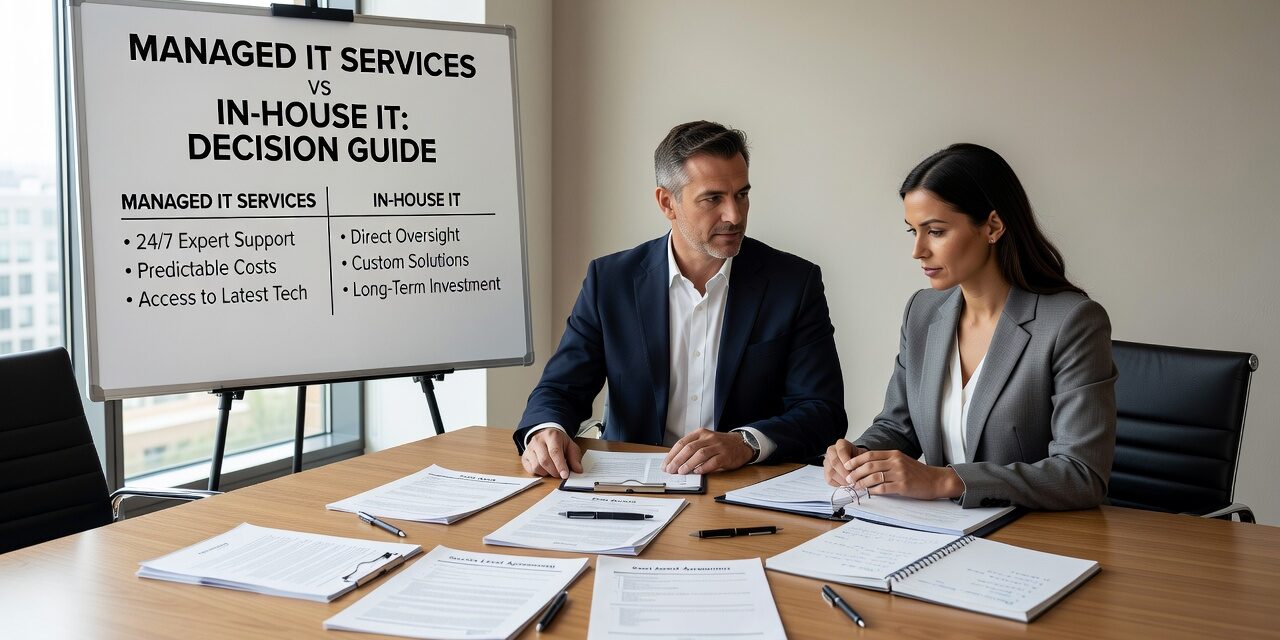
As your business grows, the technology that seemed manageable when you had 10 employees now feels overwhelming at 50 or 100. You’re spending too much time troubleshooting network issues instead of focusing on core business priorities. The question many growing companies face is whether to stick with their current approach, hire internal IT staff, or explore managed IT services vs in house IT options.
The answer isn’t one-size-fits-all, but understanding the real costs, capabilities, and operational impact of each approach will help you make the right decision for your business growth trajectory.
The True Cost Comparison
When evaluating managed IT services vs in house IT, most business owners initially compare monthly service fees against IT salaries. However, the real comparison requires looking at total ownership costs over time.
In-house IT expenses include more than salary. A mid-level IT professional typically costs $90,000-$120,000 in base salary, plus benefits, training, and management overhead. Add the cost of security tools ($20,000+ annually), backup and disaster recovery systems ($10,000+ annually), and after-hours coverage gaps, and you’re looking at $150,000+ per year for one person.
Additional hidden costs emerge quickly. When your IT person takes vacation or leaves the company, you face coverage gaps and expensive emergency consulting fees. As your business grows, one person becomes overwhelmed, leading to slower response times and project delays.
Managed IT services typically offer predictable monthly costs that include the tools, monitoring, and support team your business needs. Because providers spread these costs across multiple clients, you get enterprise-grade security tools and 24/7 coverage for significantly less than building equivalent capabilities in-house.
For most businesses with 10-100 employees, the total cost of managed services is often 30-50% less than hiring equivalent internal capabilities.
Scalability During Growth Periods
Growing businesses need IT solutions that can adapt quickly to changing requirements. This is where the differences between approaches become most apparent.
Managed services scale efficiently because providers already have the team, tools, and processes in place. When you open a new location, add remote employees, or acquire another company, your provider can extend coverage immediately without hiring delays or infrastructure buildout.
In-house teams scale slowly and expensively. Each new hire requires recruiting, interviewing, onboarding, and training. If growth slows, you’re stuck with excess capacity. If growth accelerates beyond your hiring pace, your team becomes overwhelmed and service quality suffers.
Multi-location Considerations
Businesses expanding to multiple locations face particular challenges. An in-house team can provide excellent support at headquarters but struggles to deliver consistent service across branch offices. Managed providers offer standardized support and monitoring across all locations from day one.
Security and Compliance Capabilities
Cybersecurity threats continue to evolve, and regulatory compliance requirements are becoming more complex. The security capabilities gap between approaches is often the deciding factor for growing businesses.
Managed IT providers typically include advanced security tools as part of their standard service. You get 24/7 monitoring, threat detection, email security, vulnerability scanning, and incident response capabilities that would cost tens of thousands annually to implement in-house.
These providers also maintain compliance expertise across multiple frameworks (HIPAA, PCI, SOC 2) and can guide you through audit preparation and remediation.
In-house teams offer direct control over security policies but often lack specialized expertise in emerging threats. Small internal teams struggle to provide round-the-clock monitoring and may treat security as a secondary priority behind daily support tasks.
For most growing businesses, the security advantages of managed services significantly outweigh the control benefits of in-house teams.
Support Quality and Availability
The support experience differs significantly between approaches, and the best choice depends on your specific operational needs.
In-house advantages include immediate physical presence for hands-on issues, deep familiarity with your specific systems and workflows, and informal communication channels that feel more personal and responsive.
Managed service advantages include 24/7 availability, defined response time commitments, and access to a full team of specialists rather than relying on one or two individuals. When complex issues arise, you have immediate access to experts in networking, security, cloud services, and compliance.
The key consideration is whether your business can accept after-hours downtime. If system availability during evenings and weekends directly impacts revenue or customer service, managed services provide coverage that small internal teams cannot match.
Hybrid and Co-managed Options
Many growing businesses discover that a hybrid approach offers the best combination of control and capability. This typically involves:
- Small internal team handling on-site support, user training, and business-specific system knowledge
- Managed provider delivering 24/7 monitoring, security services, backup management, and overflow project support
This approach works particularly well for businesses with 50-200 employees who need both immediate on-site responsiveness and enterprise-grade infrastructure management.
Decision Framework for Growing Companies
Choose managed services when:
- Your current IT person is overwhelmed or lacks specialized security expertise
- You’re expanding to multiple locations or adding remote workers
- Predictable monthly costs fit better than variable hiring and tool expenses
- 24/7 system availability is critical to your operations
- You need enterprise-grade security but lack the budget for internal security specialists
Choose in-house IT when:
- You have unique, complex systems requiring constant specialized attention
- Regulatory requirements demand direct control over all IT operations
- Your budget can support multiple IT professionals plus tools and training
- Physical presence is critical due to specialized equipment or manufacturing processes
Consider hybrid approaches when:
- You want some internal IT control but need managed services for monitoring and security
- Your business is large enough to justify internal staff but still needs specialized expertise
- You have multiple locations requiring both local and centralized support
What This Means for Your Business
The managed IT services vs in house IT decision ultimately comes down to matching your support model to your business growth trajectory and operational requirements. Most growing companies find that managed services provide better security, predictable costs, and scalability during critical growth phases.
The key is choosing the right provider and service level that aligns with your business needs rather than defaulting to the lowest-cost option. Look for providers who offer strategic guidance, not just reactive support, and who can grow with your business over time.
Ready to explore how the right IT support strategy can improve your operational efficiency and security? Contact our team for a consultation to discuss your specific business requirements and growth plans.