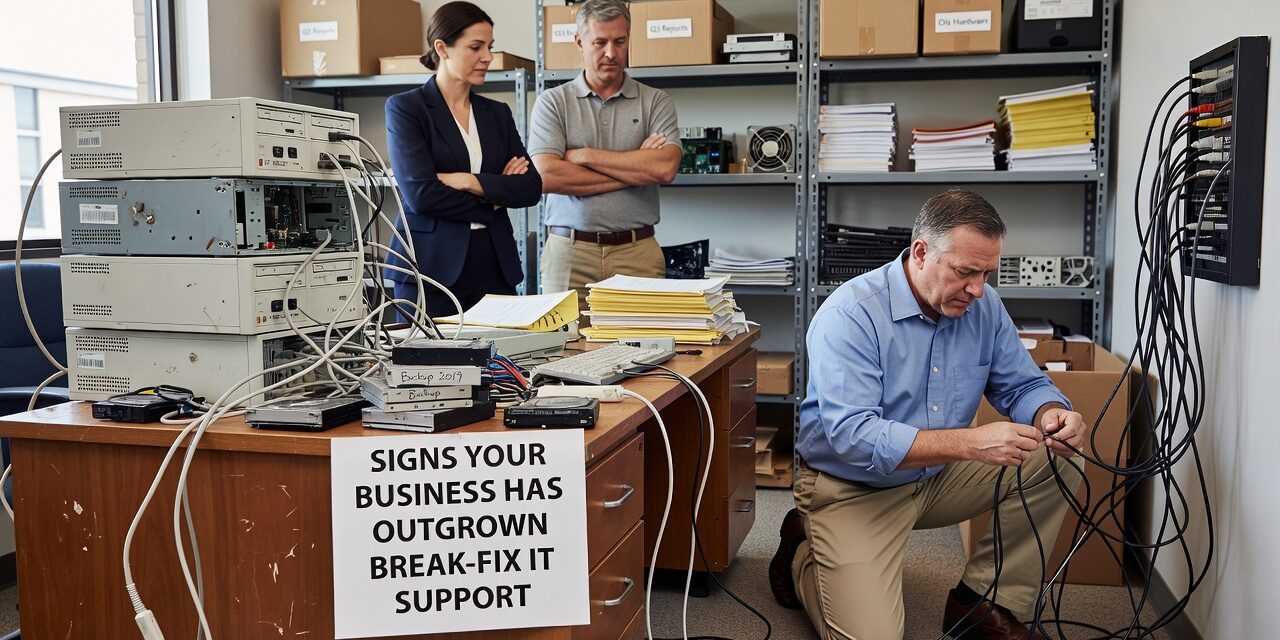
At some point, the “call us when something breaks” approach to IT support stops being a reasonable cost-saving strategy and starts becoming a liability. If your team is losing hours to recurring tech problems, waiting days for someone to fix a critical issue, or piecing together answers from multiple vendors, those are not just annoyances — they are signs your business has outgrown break-fix IT support.
Break-fix works fine when your operation is small and simple. One or two computers, a basic internet connection, maybe a shared printer. But as headcount grows, as your reliance on cloud tools deepens, and as clients start asking harder questions about your security posture, reactive support creates real gaps that compound over time.
Here is how to recognize those gaps before they turn into something more serious.
Your Recurring Problems Never Actually Get Fixed
One of the clearest signs you have outgrown break-fix support is when the same problems keep coming back. The Wi-Fi drops in the conference room. Microsoft 365 logins fail on certain machines. A specific employee’s computer slows to a crawl every few weeks. A technician fixes it, closes the ticket, and three weeks later you are calling again.
Break-fix providers get paid per incident. That model does not create any financial incentive to find the root cause. A managed IT relationship works differently — the provider’s goal is to reduce ticket volume over time, not sustain it. If you are noticing patterns in your IT problems and no one is investigating why, that is a structural issue with your support model, not just bad luck.
You Have No Visibility Into What Is Actually Happening With Your Technology
Most business owners operating on a break-fix model cannot answer basic questions about their own infrastructure: Which devices haven’t been patched in six months? Who still has access to company systems after leaving the organization? Is the backup actually running, and when was the last time anyone checked?
This blind spot is more than uncomfortable — it is a genuine operational risk. A law firm, for example, might discover during a client security questionnaire that a former employee’s Microsoft 365 account is still active. Not because anyone was careless, but because there was never a process for offboarding users, and no one monitoring the environment to catch it.
Proactive IT support includes regular monitoring, reporting, and someone who reviews the results. If your current setup produces none of that, you are operating on assumption rather than information.
Downtime Is Starting to Have a Real Business Cost
Break-fix support has a built-in delay. Something breaks, you call, someone gets dispatched or logs in remotely, the problem gets diagnosed, a fix is applied. On a good day, that takes a couple of hours. On a bad day — when the issue is complex, the vendor is unavailable, or the right parts are not in stock — it can take much longer.
For a business doing modest volume, a few hours of downtime is manageable. But consider what that same outage costs when you have ten people unable to process orders, access client files, or join a video call. Or when it happens during a product launch, a payroll run, or a client deadline.
The math changes quickly. And it changes even faster when you factor in that break-fix providers typically do not have any contractual obligation around response time. You are waiting in the queue like everyone else.
The Common Mistake: Treating IT Costs as Line Items Instead of Risk
Many operations managers compare managed IT service costs to their current break-fix invoices and conclude the latter is cheaper. This is rarely an accurate comparison. Break-fix invoices capture only the cost of visible repairs. They do not capture lost employee productivity, the hours your own team spends troubleshooting before calling for help, the cost of a security incident that went undetected, or the business you lost while your systems were down.
A more honest comparison asks: what is the total cost of IT problems to this business over the past twelve months, including the indirect costs?
Your IT Situation Has Gotten More Complex, But Your Support Has Not
Break-fix was designed for a simpler era of IT. A technician comes in, fixes the server, leaves. But most growing businesses today are running a mix of cloud and on-premise tools, supporting remote or hybrid employees, storing sensitive data across multiple platforms, and fielding growing pressure around security and compliance.
That complexity requires someone who understands your full environment — not just the device in front of them at a given moment. When you have three different vendors responsible for your internet, your software, and your hardware, and none of them talk to each other, troubleshooting becomes slow and accountability disappears. “That’s not our side of things” is a phrase many business owners hear far too often.
A single, accountable IT partner who knows your environment, maintains documentation of your systems, and can coordinate across vendors is not a luxury at this stage — it is a basic operational requirement.
You Cannot Plan Because You Cannot Predict
Break-fix IT is inherently reactive, which means budgeting for it is difficult. You never know when the next invoice is coming or how large it will be. That unpredictability is a problem for operations managers and CFOs trying to plan quarterly or annually.
Managed IT support shifts that model toward a predictable monthly cost that covers monitoring, maintenance, help desk access, and proactive work. That predictability also makes it easier to plan for hardware refreshes, software upgrades, and security improvements before they become emergencies.
If your IT spending feels like a series of unpleasant surprises rather than a planned investment, that is worth examining. Managed IT support for growing businesses is built around exactly this shift — from reactive spending to controlled, planned costs.
What This Means for Your Business
If several of the patterns above sound familiar, the issue is not that your current IT vendor is doing a poor job within the break-fix model. The issue is that the model itself is no longer a fit for where your business is now.
The right time to address this is before a significant incident forces the decision. A security breach, an extended outage, or a failed backup discovery during an audit are expensive ways to learn that your IT support structure needed to change six months ago.
TECHZN works with growing businesses in Dallas and Austin that have reached exactly this inflection point. If you want to understand what a proactive IT support structure would look like for your operation — and what it would actually cost — reach out to our team for a straightforward conversation.