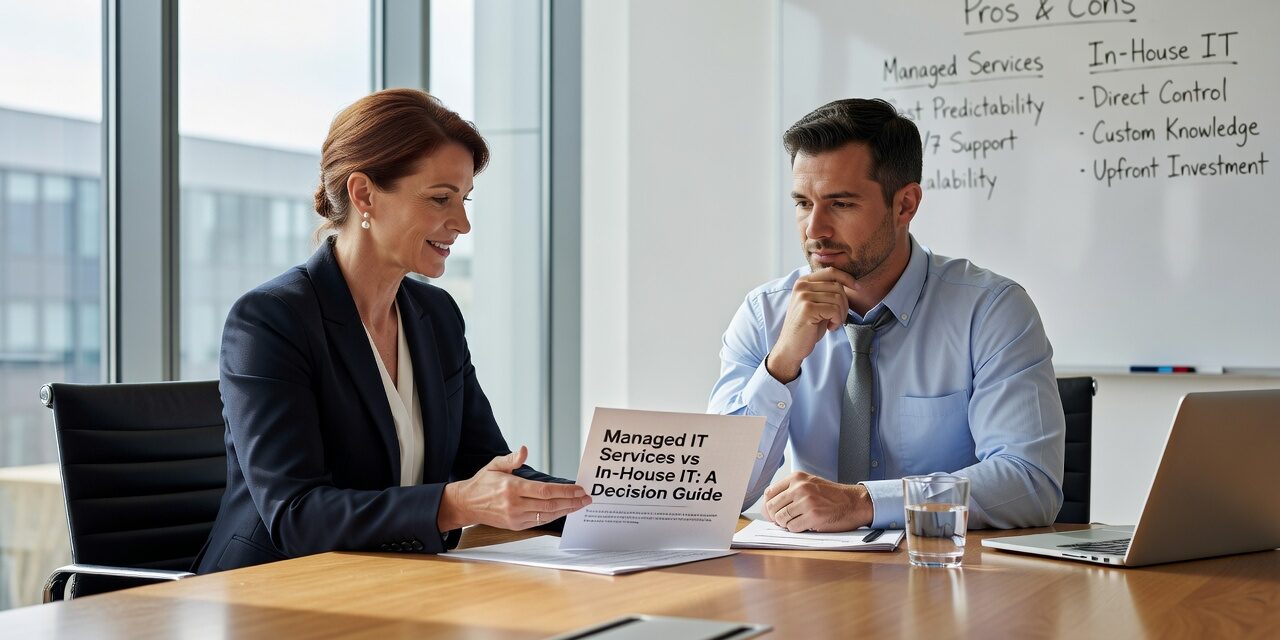
Making the choice between managing IT internally versus working with an external provider isn’t just a technology decision—it’s a business strategy that affects everything from daily operations to long-term growth. The managed IT services vs in house IT debate touches every aspect of how your business handles technology, support, and planning.
Many businesses start with an internal approach because it feels more controlled. You hire someone technical, they handle problems as they arise, and you maintain direct oversight. But as companies grow and technology becomes more complex, this model often reveals limitations that can impact productivity and create unexpected risks.
When Internal IT Makes Sense—and When It Doesn’t
Internal IT works well for businesses with predictable technology needs and sufficient budget to hire specialized staff. If your company has complex compliance requirements or highly customized systems, having dedicated internal expertise can provide the deep knowledge and immediate access you need.
However, most growing businesses hit common pain points with the internal model. Your IT person becomes overwhelmed handling everything from password resets to major security updates. They’re constantly firefighting instead of planning strategic improvements. When they take vacation or leave the company, you’re left without critical support.
The cost factor often surprises business owners. A skilled IT professional in Dallas or Austin commands a significant salary, plus benefits, training, and equipment costs. Yet they’re still just one person with specific expertise—they might excel at network management but struggle with cybersecurity, or handle day-to-day support well but lack experience with business continuity planning.
What Managed IT Services Actually Provide
Managed IT services operate on a fundamentally different model. Instead of one person handling all technology needs, you get access to a team with varied expertise. Network specialists handle infrastructure issues, security experts manage threat prevention, and help desk technicians resolve daily problems—all working together on your behalf.
The service typically includes proactive monitoring that catches problems before they affect employees, regular maintenance that prevents recurring issues, and strategic planning that aligns technology with business goals. Most importantly, you get predictable monthly costs instead of surprise expenses when equipment fails or security incidents occur.
Response times improve because multiple technicians can handle issues simultaneously. If your main contact is unavailable, someone else familiar with your environment steps in immediately. This redundancy eliminates the single point of failure that internal IT often creates.
Co-Managed IT: A Hybrid Approach
Some businesses choose co-managed IT, which combines internal staff with external expertise. Your internal person handles day-to-day user support and understands your specific business processes, while the managed service provider handles complex infrastructure, security monitoring, and strategic projects.
This model works particularly well when you have an IT-savvy employee who’s become overwhelmed but provides valuable institutional knowledge. Instead of replacing them entirely, you supplement their skills with specialized external support. The internal person focuses on what they do best while gaining backup for areas outside their expertise.
Co-managed arrangements often prove more cost-effective than hiring multiple internal specialists while maintaining the personal touch that comes with dedicated staff.
Making the Financial Comparison
The managed IT services vs in house IT cost comparison extends beyond salary differences. Internal IT requires ongoing training investments to keep skills current, particularly in rapidly evolving areas like cybersecurity and cloud services. You also absorb the cost of their learning curve when new technologies or challenges arise.
Manaaged services spread these costs across multiple clients, making specialized expertise more affordable for individual businesses. The provider invests in training, certifications, and advanced tools that would be prohibitively expensive for one company to maintain internally.
Downtime costs often tip the scale toward managed services. When your internal IT person can’t resolve a critical issue quickly, you’re paying for both their time and lost productivity across your entire team. Managed service providers typically offer faster resolution times and better escalation procedures for complex problems.
Security and Compliance Considerations
Cybersecurity presents one of the strongest arguments for managed services. Keeping up with evolving threats, compliance requirements, and security best practices has become a full-time job that requires specialized knowledge and constant vigilance.
Most internal IT staff lack the deep security expertise that businesses need today. They’re often responsible for so many other tasks that security becomes reactive rather than proactive. Managed service providers typically include dedicated security specialists who monitor threats, manage updates, and implement comprehensive protection strategies.
For businesses in regulated industries, managed services often provide better compliance support. The provider maintains expertise across multiple compliance frameworks and can implement appropriate controls more efficiently than most internal teams.
What This Means for Your Business
The managed IT services vs in house IT decision ultimately depends on your specific situation, but most growing businesses find that managed services provide better value, reliability, and strategic capability than trying to handle everything internally.
Start by honestly assessing your current IT challenges. Are you dealing with recurring problems, slow response times, or lack of strategic planning? Do security concerns keep you awake at night? Is your IT person overwhelmed or lacking expertise in critical areas?
If you’re experiencing these issues, it’s time to explore how managed IT support for growing businesses can provide the expertise, reliability, and strategic support your company needs to thrive. Contact TECHZN to discuss how our team can complement or enhance your current IT approach.