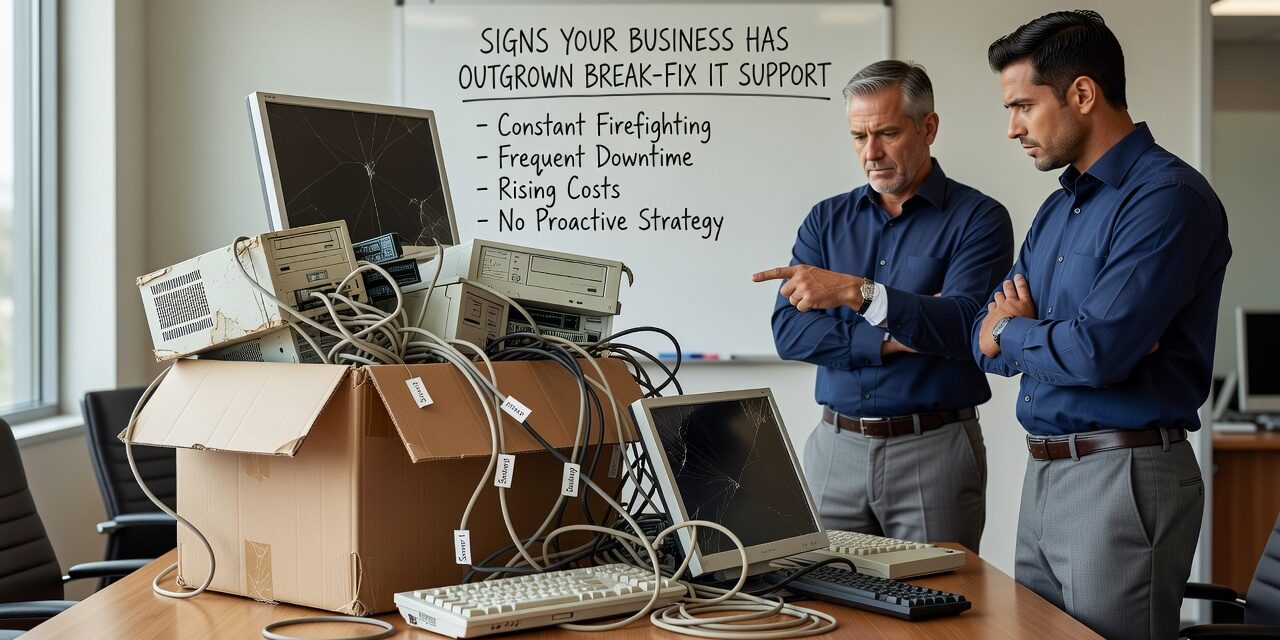
If you’ve noticed that IT problems keep coming back, that someone on your team is spending hours each week dealing with tech issues that aren’t their job, or that a single outage can halt your entire operation—those aren’t isolated incidents. They’re signs your business has outgrown break-fix IT support.
Break-fix support works on a simple premise: something breaks, you call someone, they fix it, you pay. For a very small office with minimal technology, that model can work. But as your business grows, that reactive approach starts creating real operational and financial risk.
What Break-Fix IT Support Actually Costs You
The obvious cost is the invoice you get after each service call. The hidden costs are harder to see on a spreadsheet—but they add up fast.
When you’re paying per incident, no one is watching your systems between those calls. There’s no monitoring to catch a failing hard drive before it takes down a server. There’s no one reviewing whether your backups are actually completing. There’s no process for keeping your software patched and up to date.
Consider a common scenario: a law office or accounting firm running on a server that hasn’t been updated in two years. No one realizes there’s an issue until the server fails the week before a major deadline. The break-fix vendor gets it running again—four days later. That downtime isn’t just inconvenient. It affects client deliverables, employee hours, and potentially your reputation.
The real problem with break-fix isn’t just cost. It’s unpredictability. You can’t plan around it. You can’t budget for it. And every time something breaks, you’re starting from scratch with someone who may not know your environment.
The “Someone on Staff Is Doing IT” Problem
One of the clearest signs your business has outgrown break-fix IT support is when IT tasks start falling to whoever is most comfortable with technology—your office manager, your CFO, or maybe a department head who’s good with computers.
This happens gradually. At first, it’s just resetting a password or helping someone connect to the printer. Then it’s setting up new laptops, troubleshooting email issues, and calling your internet provider when the connection goes down. Before long, that person is spending 10 or more hours a week on IT work that was never part of their role.
The risk here goes beyond wasted hours. When a non-IT person is managing your technology, critical things tend to fall through the cracks:
- New employee accounts get set up inconsistently
- Departing employees may still have access to company systems weeks later
- Backups aren’t tested, so no one knows if they actually work
- Security patches get skipped because no one knows they’re needed
None of this is the fault of the person doing their best to help. It’s a structural problem—and it’s a signal that your IT needs have grown beyond what informal support can safely handle.
When Recurring Problems Are the Norm
Another telling sign: the same issues keep coming back.
The Wi-Fi drops in the conference room every time there’s a big meeting. Microsoft 365 slows down at certain times of day and no one knows why. A specific employee’s laptop has been “fixed” three times in six months. Your VPN disconnects constantly for remote staff.
Break-fix vendors solve the immediate symptom. They rarely have the time, the access, or the incentive to find the underlying cause. That’s not a criticism—it’s the nature of the model. When you pay per visit, the vendor’s job is to get you back up and running, not to document patterns and engineer a long-term fix.
Recurring problems are expensive in ways that don’t show up on IT invoices. They show up in lost productivity, frustrated employees, and the slow erosion of confidence your staff has in the tools they’re supposed to rely on.
The Common Blind Spot: “We Haven’t Had a Major Incident”
Many business owners stick with break-fix because things seem fine. No major data breach. No catastrophic outage. No obvious reason to change.
This is the most dangerous position to be in.
What you don’t see with break-fix is what’s quietly accumulating in the background: unmonitored devices, outdated software, no tested backup plan, no one reviewing who has access to what. These aren’t problems until they suddenly are—and when they become problems, the consequences tend to be severe.
A ransomware attack that encrypts your files doesn’t care whether you’ve been lucky so far. A server failure at the worst possible time doesn’t give you a warning. The businesses that recover quickly from these situations are the ones that had monitoring, documentation, and a response plan already in place. That infrastructure doesn’t exist in a break-fix relationship.
Practical Signs It’s Time to Reassess
Here’s a straightforward way to evaluate where you stand:
- You can’t answer basic questions about your own IT environment. Do you know what software is installed on every computer? Do you know when your last successful backup ran? Do you know who has admin access to your systems?
- IT issues are affecting your ability to serve clients or meet deadlines. If technology problems are showing up in client conversations or internal bottlenecks, that’s a business problem—not just an IT problem.
- You have no written documentation. No network diagram, no list of vendor contacts, no record of what was done during the last service call.
- You’re paying per incident but don’t know what you’re actually spending annually. Add up your IT invoices from the past 12 months. For many growing businesses, the total surprises them.
- You’re planning to add staff, open a new location, or move to a new office. Break-fix support is particularly poorly suited for transitions. There’s no one proactively planning for what your technology will need six months from now.
If two or more of those apply to your situation, it’s worth having a candid conversation about what a more structured IT support model would look like for your business. Managed IT support for growing businesses typically includes proactive monitoring, documented systems, defined response times, and a support team that already knows your environment before something goes wrong.
What This Means for Your Business
Outgrowing break-fix IT support isn’t a failure—it’s a sign your business has grown. The model that worked when you had five employees and one server simply isn’t built for a team of 25 using cloud applications, remote access, and multiple locations.
The shift to a more proactive IT support model isn’t about spending more. For many businesses, it actually reduces overall IT costs by preventing the expensive, disruptive failures that break-fix support can’t stop. More importantly, it means your technology is being managed—not just repaired.
If you’re based in the Dallas or Austin area and want to talk through what IT support should look like for a business at your stage, TECHZN’s team is available for a straightforward assessment with no sales pressure.