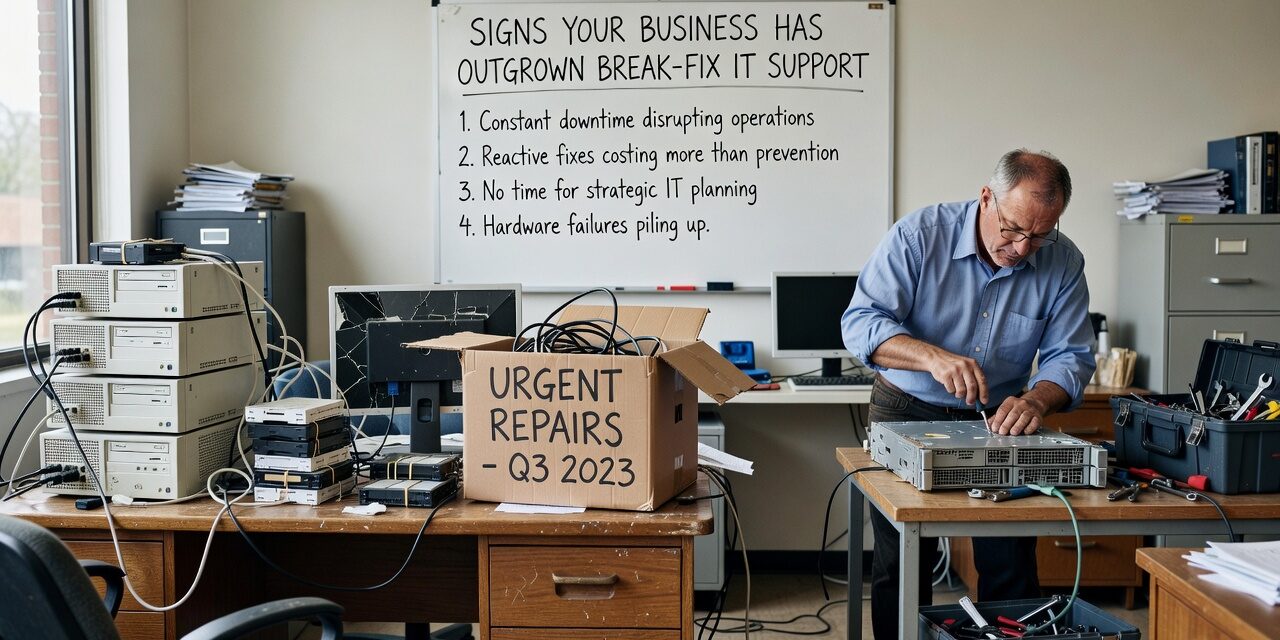
If your staff is waiting hours for IT help, the same problems keep coming back, and nobody can tell you what your technology costs will look like next quarter—those aren’t minor annoyances. They’re signs your business has outgrown break-fix IT support and that the model you’re running on is working against you.
Break-fix support made sense when your operation was simpler. Something broke, you called someone, they fixed it, you paid the bill. But as your team grows, your systems multiply, and your clients expect more from you, that reactive approach starts costing more than it saves.
Here’s how to recognize where the model is breaking down—and what to do about it.
The Recurring Problem Trap
One of the clearest signs you’ve outgrown break-fix support is when the same issues keep surfacing. A workstation that crashes every few weeks. A printer that loses connection to the network every time someone installs an update. A VPN that slows to a crawl when more than five people are on it.
Break-fix vendors get paid to fix problems, not prevent them. So there’s no financial incentive for them to investigate root causes. They close the ticket, you pay the invoice, and the cycle repeats.
If you look back at your last six months of IT issues and see the same items coming up repeatedly, that’s not bad luck. That’s a support model that’s treating symptoms instead of solving problems.
Response Times That Don’t Match Your Business Reality
Think about what happens when your point-of-sale system goes down at noon on a Friday, or your team can’t access shared files at the start of a client presentation. With break-fix support, your priority is determined by how busy your vendor is that day—not by how much revenue or reputation is on the line for you.
Slow response times are easy to overlook when things are generally stable. But the moment a critical system fails, that gap becomes very visible. And the cost of downtime—staff sitting idle, deadlines missed, clients waiting—adds up faster than most owners expect.
A business with ten employees sitting unproductive for two hours isn’t just an inconvenience. It’s a real operational loss. If your current IT support can’t commit to a clear response window, that’s a meaningful risk to how your business runs day to day.
No Roadmap, No Budget Visibility
Break-fix support is inherently unpredictable. You don’t know what you’ll spend next month, which makes planning harder. Worse, nobody is watching your environment closely enough to warn you that your server is three years past its useful life, or that your Microsoft 365 licenses don’t cover the security features your business actually needs.
This is where a lot of growing businesses make a costly mistake: they assume that because nothing has broken recently, everything is fine. That assumption gets tested when a piece of aging hardware fails without warning, or when they discover their backups haven’t been completing successfully for months.
A proactive IT partner—as opposed to a break-fix vendor—tracks your asset lifecycles, flags upcoming risks, and helps you plan purchases before they become emergencies. If no one is doing that for your business right now, you’re flying without instruments.
The Coordination Problem Across Vendors and Tools
As businesses grow, they tend to accumulate technology: cloud platforms, line-of-business software, networking gear, communication tools. With break-fix support, each of those often involves a different vendor, a different phone number, and a different conversation when something goes wrong.
Here’s a scenario that plays out more often than most owners realize: your internet goes down, your phone system is cloud-based, and your staff can’t work. You call your ISP. The ISP says the issue is on your local network. You call your IT vendor. They say it might be the ISP. Meanwhile, an hour passes.
This kind of finger-pointing happens when no single party owns the full picture of your IT environment. If your team regularly doesn’t know who to call first when something breaks, that’s a sign your support structure hasn’t kept pace with your complexity.
When Workarounds Become Standard Operating Procedure
Pay attention to the informal habits your team has developed around technology. Are people saving files to their desktop instead of shared drives because the shared drive is slow or confusing? Are they using personal email to send documents because the company system is clunky? Have they stopped using a particular tool because it never works right?
These workarounds feel harmless, but they signal two things. First, your technology isn’t working well enough for people to use it as intended. Second, nobody is accountable for fixing the underlying problem—because your support model only responds when something is completely broken, not when it’s just inconvenient or inefficient.
Workarounds also create security exposure. Staff using unapproved apps or personal accounts to get work done can introduce vulnerabilities your IT vendor may never know about.
What to Look for in a Different Approach
If several of the above patterns sound familiar, the question isn’t whether to make a change—it’s what kind of change makes sense.
A few practical things to look for:
- Defined response times in writing. Any support agreement should clearly state how fast you can expect a response for different types of issues—and there should be accountability when that standard isn’t met.
- Proactive monitoring. Your IT support should be catching problems before your staff notices them, not waiting for a ticket to come in.
- A named contact who knows your environment. You shouldn’t have to explain your setup from scratch every time you call.
- Technology planning, not just troubleshooting. At least once or twice a year, someone should be sitting down with you to review what you have, what’s aging out, and what’s coming.
For businesses in Texas that are working through this decision, exploring managed IT support for growing businesses can clarify what a more structured support relationship actually looks like in practice.
What This Means for Your Business
Break-fix support isn’t a bad product—it’s just a product designed for a simpler time. If your business has grown, added staff, expanded to multiple locations, or started relying more heavily on cloud tools and remote work, your IT support model needs to reflect that.
The signs are usually there before things get critical: recurring tickets, slow response, no planning, workarounds everywhere. Recognizing them early gives you time to make a deliberate decision rather than a reactive one.
TECHZN works with small and midsize businesses across Dallas and Austin to evaluate where break-fix support is creating gaps—and to put a more reliable structure in place. If you’re not sure where you stand, reach out for a straightforward IT assessment with no obligation.