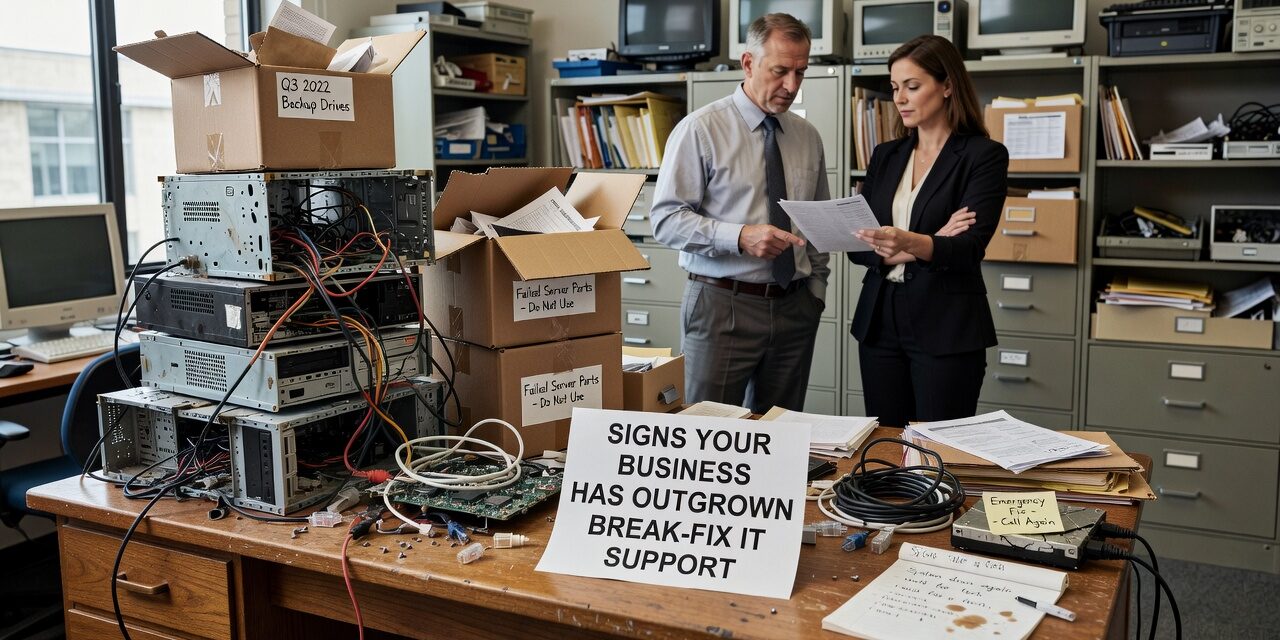
At some point, calling your IT guy when something breaks stops being a workable plan. It feels manageable at first — an occasional laptop issue here, a printer problem there. But there’s a pattern that tends to show up as businesses grow, and once you know what to look for, the signs your business has outgrown break-fix IT support are hard to miss.
Break-fix isn’t inherently wrong. For very small operations with minimal technology needs, it can be perfectly adequate. The problem is that most businesses don’t notice when they’ve crossed the line — and by the time they do, they’ve already absorbed a lot of avoidable cost and disruption.
The Same Problems Keep Coming Back
One of the clearest warning signs is a recurring issue that never actually gets resolved. A server that intermittently goes down. A VPN that fails for remote staff every few weeks. Microsoft 365 accounts that get locked out repeatedly without anyone investigating why.
Break-fix support is designed to fix what’s in front of the technician right now. It is not designed to identify root causes, document what was done, or build toward a more stable environment. When the same issue resurfaces a month later, you call again, pay again, and explain the problem from scratch — often to a different person.
For a business running 20 or 30 employees, this pattern quietly drains productivity. Each incident pulls staff away from their actual work. Each call generates a bill. And the underlying problem continues.
Response Times That Don’t Match Your Risk
How long can your business operate without its core systems? For many operations, the honest answer is a few hours — maybe less.
Break-fix providers typically respond when they’re available. If you call at 4:45 PM on a Friday and your accounting software is down, you may not hear back until Monday. If your internet drops during a client presentation, or your point-of-sale system fails during a busy period, there’s no guarantee anyone is prioritizing your problem.
This becomes especially visible during critical moments: an office move that disrupts phones and internet access, a hardware failure right before payroll, or a security issue that requires immediate action. Without a defined service level agreement, response time is essentially a guess.
Growing businesses often discover this gap the hard way — not during routine issues, but during the incidents that matter most.
You Don’t Actually Know What You Have
A common blind spot for businesses still on break-fix support: nobody has a clear picture of the technology environment. No complete list of devices. No documentation of who has access to what. No record of when hardware was last updated or when software licenses expire.
This creates real problems. When an employee leaves, you might not know all the accounts that need to be disabled. When a vendor asks for your network details during a support call, nobody has them. When you want to add a new location, there’s no baseline to plan from.
IT that only shows up when something breaks has no incentive to document anything. They fix the immediate problem and move on. What gets left behind is an undocumented environment that becomes harder and riskier to manage over time.
The Hidden Cost of Break-Fix Adds Up
Many business owners assume break-fix is the cheaper option because there’s no monthly fee. That math doesn’t hold up once you factor in what you’re actually spending.
Consider a business that calls for IT support six to eight times per year. Add up the hourly rates, after-hours premiums, and any emergency fees. Then factor in what those incidents actually cost in staff downtime — an office of 15 people unable to access shared files for three hours is a significant loss that never appears on an IT invoice.
There’s also the cost of not doing things: no proactive patching means more vulnerabilities. No monitoring means outages are discovered by employees rather than caught early. No backup verification means a data loss event becomes catastrophic rather than recoverable.
The reactive model looks cheaper until something goes wrong. At that point, the comparison shifts quickly.
When to Start Thinking Differently About IT Support
There’s no single employee count or revenue threshold that triggers the need for a more structured IT model. But a few situations tend to signal it clearly:
- You’re adding staff or locations, and IT complexity is growing faster than your ability to manage it.
- You’ve had a security incident — even a minor one — and realized you don’t have a clear process for handling it.
- Your team is losing meaningful time to IT problems, and those problems aren’t getting resolved permanently.
- You’re handling sensitive data, such as client financial information, health records, or contracts that carry compliance implications.
- Your current IT contact has no documentation, no backup plan, and no formal agreement about what they’ll cover or how fast they’ll respond.
None of these situations means you need to build an internal IT department. For most businesses in the 25–150 employee range, that’s neither practical nor cost-effective. What it does mean is that managed IT support for growing businesses is worth a serious look — one where monitoring, response times, documentation, and security are defined upfront rather than negotiated in the middle of an outage.
What a Proactive IT Model Actually Covers
Moving away from break-fix doesn’t mean handing over control. It means shifting from a purely reactive model to one where problems are caught earlier, response expectations are written down, and someone is responsible for the health of your environment on an ongoing basis.
A structured IT arrangement typically includes:
- Monitoring and alerting, so issues are caught before they become outages
- Regular patching and updates applied on a schedule, not only when something breaks
- Documented processes for onboarding, offboarding, and common support requests
- A defined help desk, so employees know who to call and what to expect
- Backup verification, not just backup setup — someone actually confirms the data is recoverable
- Security baselines, including multi-factor authentication, endpoint protection, and access controls
This is a meaningfully different operating model than calling someone when a server goes down.
What This Means for Your Business
If your current IT support only shows up when things break, and your business has grown past the point where that’s manageable, it’s worth being honest about what that’s actually costing you — in downtime, in risk, and in the slow accumulation of problems that never quite get fixed.
TECHZN works with businesses in Dallas and Austin that have reached exactly this point. If you’d like to talk through what a different approach would look like for your operation, reach out to the TECHZN team for a straightforward conversation — no pressure, no pitch deck.