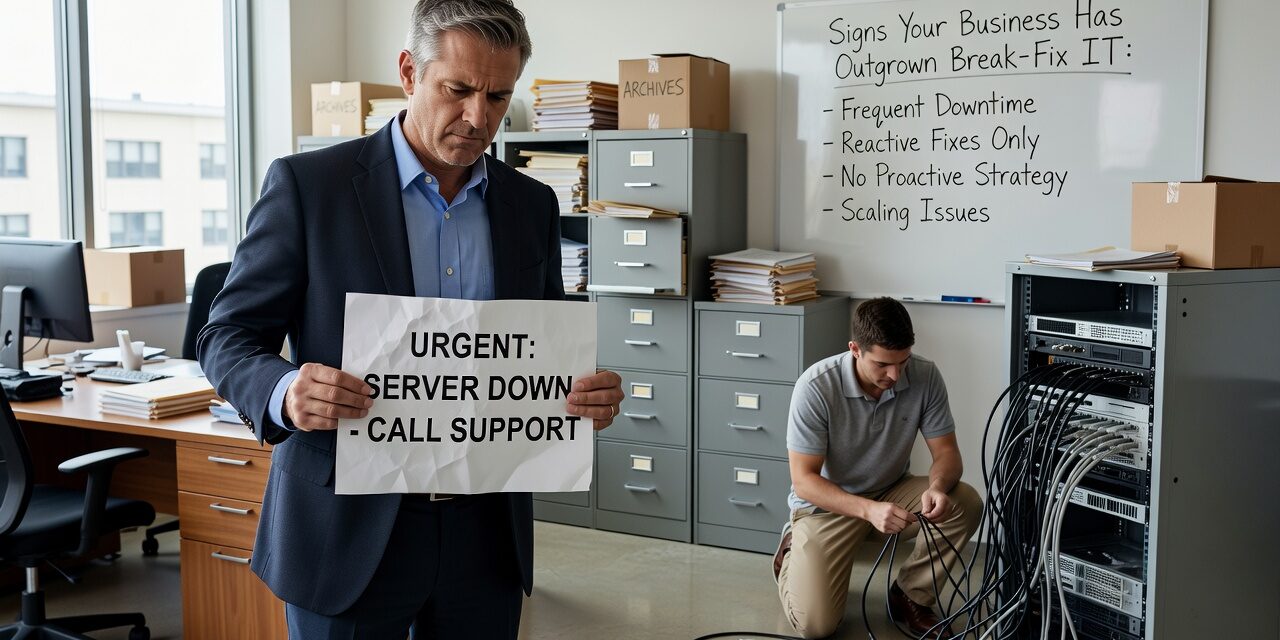
At some point, calling a technician after something breaks stops being a cost-effective strategy and starts becoming a liability. If your team is regularly waiting on IT fixes, if the same problems keep coming back, or if your business has grown to the point where downtime actually costs you money — those are signs your business has outgrown break-fix IT support.
Break-fix works well for very small operations with minimal technology dependencies. But once your business crosses certain thresholds — more staff, more locations, more reliance on cloud tools and connected systems — the reactive model starts creating problems that compound over time.
Here is how to tell if you have reached that point.
Your Downtime Costs More Than Your IT Bills
Break-fix support is priced around individual incidents. You call, someone comes, they fix it, you pay. The model feels affordable right up until you calculate what the downtime actually cost while you were waiting.
A five-person office that loses email access for three hours may lose $1,500 or more in combined productivity, missed client responses, and delayed work — for an incident that a monitored system might have flagged and resolved in minutes. When your staff is larger or your operations are more time-sensitive, those numbers rise fast.
The practical test: track how many hours per quarter your team loses to IT problems, then multiply by average hourly labor cost. If that number consistently exceeds what a managed support agreement would cost, the math has already turned against you.
The Same Problems Keep Coming Back
One of the clearest signs you have outgrown break-fix is recurring issues. A printer drops off the network every few weeks. A VPN connection is unreliable but only for certain users. Microsoft 365 keeps prompting staff for re-authentication in a way no one can explain.
Break-fix resolves the symptom. It rarely investigates the root cause, because the billing model does not reward that kind of deeper work. A technician comes in, restores the connection, and closes the ticket. Two weeks later, the same ticket gets opened again.
Recurring IT issues are not bad luck — they are a signal that no one owns your environment. Without consistent monitoring and documentation, problems get patched instead of fixed. Over time, small unresolved issues stack up into a fragile, unpredictable infrastructure.
You Have No Visibility Into What Could Go Wrong Next
This is a blind spot that many growing businesses do not recognize until something serious happens.
In a break-fix model, you typically have no dashboard, no alerts, and no one watching your systems proactively. You find out about a problem when a staff member walks over to say something is not working. You find out your backup failed when you actually try to restore from it. You find out your server is running critically low on storage the day it stops functioning.
A common scenario: a business schedules an office move and assumes everything will work fine at the new location. No one checks whether the internet circuit was provisioned correctly, whether the phone system needs reconfiguration, or whether the new network will handle the volume of connected devices. On day one, half the staff cannot get online and the phone system is down. That kind of situation is entirely avoidable with proactive planning, but break-fix support has no mechanism for it.
Proactive visibility is not a luxury — it is what separates businesses that plan around technology from businesses that are constantly surprised by it.
Your IT Support Cannot Scale With Your Team
Break-fix works at a certain size. When you have five employees and your IT needs are mostly hardware and email, one technician on call is probably fine.
Once you move past that threshold — more staff, remote workers, multiple offices, cloud services, compliance requirements — the on-call model starts to crack. Response times stretch. The technician who knows your setup is suddenly unavailable. New staff members cannot get set up quickly because there is no documented onboarding process. A security incident surfaces and no one has a clear response plan.
Growing companies often stay in break-fix too long because it feels cheaper. But the hidden costs accumulate: staff time lost to IT friction, security risks from unpatched systems, and the compounding effect of deferred maintenance. By the time a business makes the switch to managed IT support for growing businesses, they are often already dealing with a backlog of infrastructure problems that should have been addressed months earlier.
You Have No One Thinking About IT Strategy
Break-fix is inherently reactive. There is no one in your corner thinking about what your technology needs to look like in six months, helping you budget for hardware refreshes, or advising you on whether your current setup can support a new hire or a second office.
This matters more than most business owners expect. Technology decisions made without a strategic lens tend to create expensive problems later. A company that keeps adding software tools without auditing licensing costs ends up overspending on unused seats. A business that delays server upgrades because nothing has broken yet ends up replacing hardware under emergency conditions, at emergency pricing.
If no one is reviewing your IT environment regularly, identifying risks, and helping you make decisions before they become urgent, you are not managing your technology — you are just reacting to it.
What Practical Decision-Making Looks Like Here
Before dismissing managed support as unnecessary overhead, ask yourself these questions:
- How many hours did my staff lose to IT issues last quarter?
- Has the same IT problem come up more than twice in the past six months?
- Do I know whether my backups actually work?
- If my internet went down tomorrow, does anyone have a plan?
- Is anyone advising me on whether my current setup can handle growth?
If most of those answers are unclear or concerning, you are past the point where break-fix is the right fit.
What This Means for Your Business
Break-fix IT support is not a bad model — it is just a model designed for a different kind of business than the one you may be running now. When technology is central to how you serve customers, manage operations, or support staff across locations, reactive support creates gaps that grow over time.
The decision to move to a more structured IT support model is not just about fixing problems faster. It is about having consistent visibility, documented systems, and someone who treats your IT environment like it matters — not just when something breaks.
If you are based in the Dallas or Austin area and want to talk through what a better IT support model might look like for your business, TECHZN works with growing companies to build reliable, right-sized IT programs. Reach out to learn more about outsourced IT support options that fit where your business is headed.