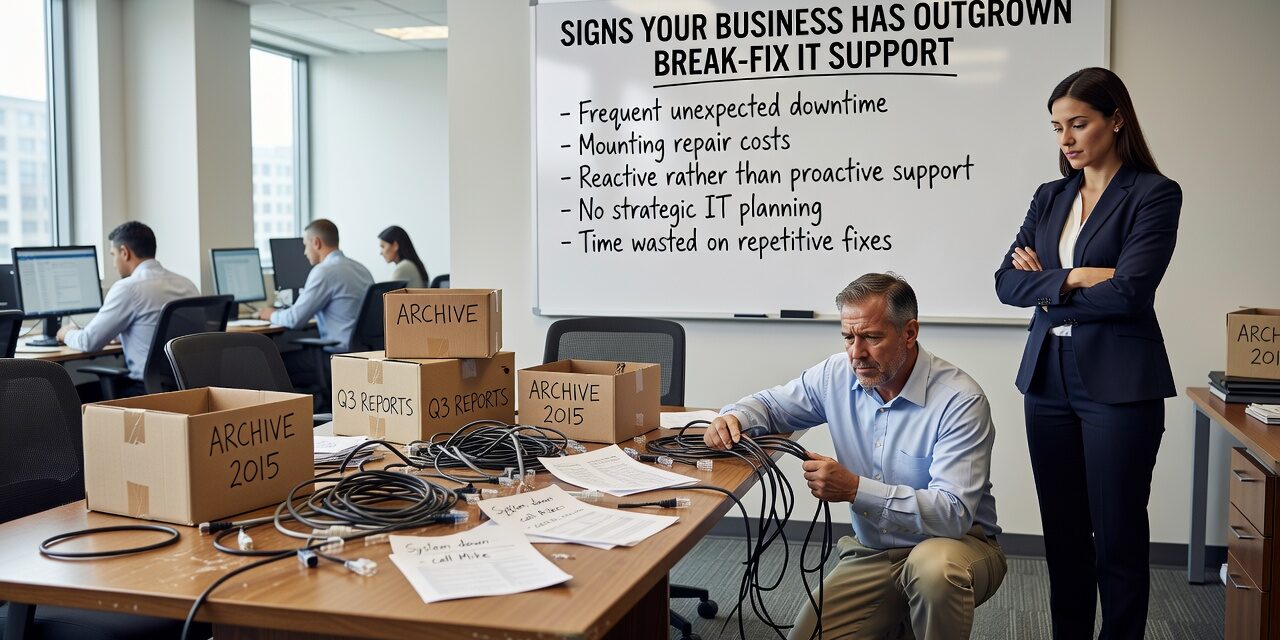
If your team is waiting hours for IT help, dealing with the same problems month after month, or finding out about outages after customers already have — your current IT support model may not be keeping up. These are some of the clearest signs your business has outgrown break-fix IT support, and ignoring them tends to get more expensive over time.
Break-fix support made sense when your IT needs were simple. You call when something breaks, someone fixes it, you pay the invoice. But as your team grows, your reliance on technology deepens, and the cost of downtime rises, that reactive model starts creating real operational drag.
Your Team Is Filing the Same Tickets Over and Over
One of the most telling signs is a help desk queue full of recurring issues. A printer that gets stuck every Tuesday. A VPN that drops for remote staff. A shared drive that periodically becomes inaccessible. These are not random events — they are symptoms of unresolved root causes.
Break-fix providers are typically paid to respond and resolve the immediate problem. There is no financial incentive for them to investigate why the problem keeps happening. So it keeps happening. Your staff works around it, submits another ticket, and loses another hour of productive time.
When recurring problems become background noise in your office, that is a sign your IT support has shifted from a business asset to a maintenance burden.
Requests Sit in a Queue While Work Slows Down
Consider a common scenario: a new hire starts on Monday, but their laptop is not configured until Wednesday. Or a Microsoft 365 license issue prevents an employee from accessing shared files for two days while a ticket works its way through a queue. These delays are easy to dismiss individually, but they add up — and they signal a support model that is not built around your business rhythm.
Stalled IT requests are not just an inconvenience. They create downstream problems: missed deadlines, frustrated staff, and workarounds that sometimes introduce their own risks.
Break-fix support often has no formal SLA — no committed response time, no priority tier system, no escalation path. You get help when they have availability. For a five-person company, that might be acceptable. For a 30- or 50-person team where multiple departments depend on connected systems, it usually is not.
You Are Finding Out About Problems After They Have Already Caused Damage
This is one of the costliest blind spots in break-fix IT: you only know something is wrong when a user notices it.
A server running low on disk space does not announce itself. An internet connection that starts dropping packets at 2 AM does not send an alert to anyone. A backup that has been silently failing for three weeks is not discovered until you actually need to restore something — and then you find out there is nothing to restore.
Proactive monitoring — where systems are watched continuously and alerts fire before users are affected — is rarely part of a break-fix arrangement. It requires infrastructure, tooling, and ongoing attention. Without it, your business is essentially waiting for something to fail before taking action.
One office manager described it this way: they discovered their nightly backups had not been completing for over a month only when they needed to recover a file after a ransomware incident. The break-fix provider had fixed the ransomware issue but had never confirmed that backups were actually running.
No One Owns the Full Picture of Your IT Environment
As companies grow, IT complexity grows with them. You might have internet from one provider, phone systems from another, cloud storage through Microsoft 365, a line-of-business application managed by a software vendor, and hardware under warranty from a fourth company. Who coordinates all of that when something goes wrong?
In a break-fix model, the answer is often: you do.
That coordination burden falls on whoever called for help — usually someone without deep technical knowledge — trying to get multiple vendors to talk to each other while business operations sit idle. It is a common and underappreciated source of downtime. And it gets worse when the root cause crosses vendor boundaries, which it often does.
A structured support relationship — where a single point of contact owns vendor coordination on your behalf — eliminates a significant amount of that friction. For growing teams managing multi-location setups or complex cloud environments, this matters a great deal.
IT Planning Feels Reactive Instead of Intentional
Here is a practical decision-making signal worth paying attention to: when did you last review whether your current IT infrastructure can actually support where your business is headed?
Most break-fix arrangements do not include technology planning. They are transactional. A provider fixes what is broken today but has no visibility into what you are building toward next quarter. That means hardware replacement often happens after failure rather than before. Licensing gets reviewed only when someone cannot log in. Network capacity gets assessed only when things start slowing down noticeably.
Growing businesses need IT that looks ahead, not just IT that reacts. If your current support model does not include regular reviews of your environment, capacity, and security posture, you are almost certainly accumulating risk you cannot see.
Some questions worth asking internally:
- Has anyone reviewed your backup and recovery process in the past six months?
- Do you have a clear picture of who has access to what systems — and why?
- If you added 20 employees next quarter, would your current network and help desk capacity handle it?
If those questions feel difficult to answer, that is not a reflection of your team’s capabilities. It is a reflection of a support model that was not designed to answer them.
What This Means for Your Business
Break-fix IT support is not inherently bad — it is simply built for a different stage of business. When recurring problems, slow response times, reactive planning, and unmonitored systems start showing up together, they tend to compound. Downtime gets longer. Recovery costs more. Staff frustration builds. And the business carries more technology risk than its leadership realizes.
If several of the patterns described here feel familiar, it may be worth evaluating what a more structured support model could look like for your size and type of operation. For businesses in the Dallas or Austin area exploring their options, managed IT support for growing businesses from TECHZN offers proactive monitoring, help desk coverage, and vendor coordination built around your day-to-day operations.
TECHZN works with small and midsize businesses across Dallas and Austin. If you would like to talk through what a better IT support structure could look like for your team, reach out for a straightforward conversation — no sales pitch, just practical guidance.