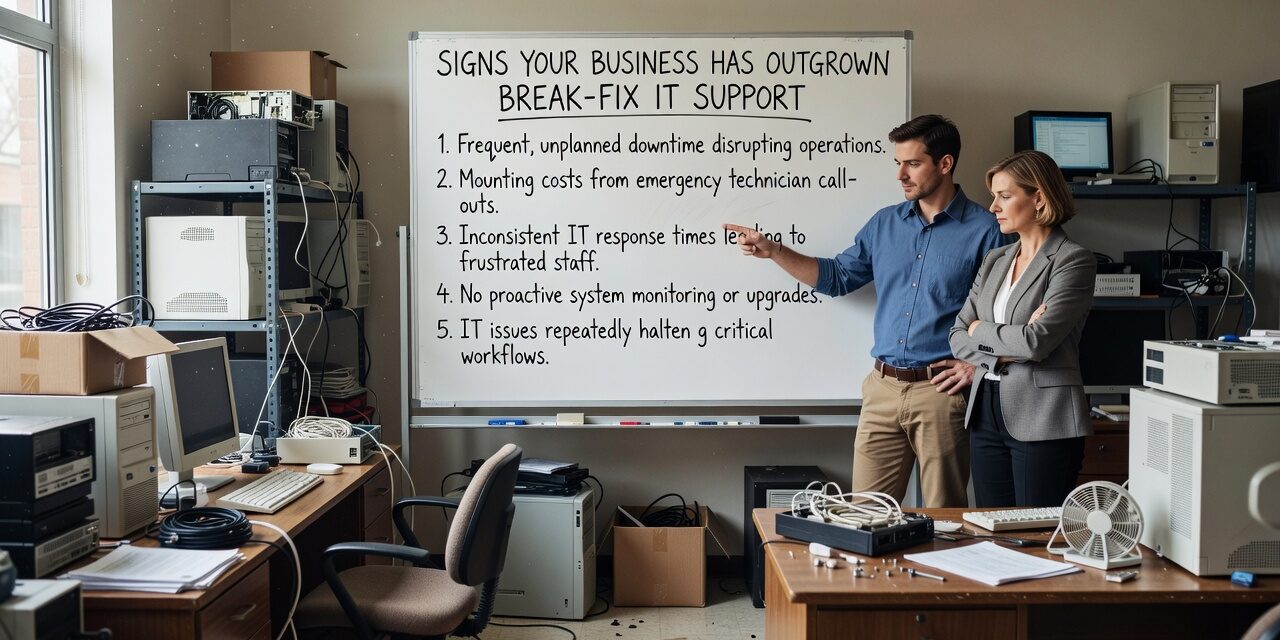
If your team has started treating IT problems like background noise—something that just happens, gets fixed eventually, and happens again—that’s worth paying attention to. The signs your business has outgrown break-fix IT support are often hiding in plain sight. They don’t always look like a crisis. Sometimes they look like a slow afternoon, a delayed client deliverable, or a staff member who’s learned to just restart their computer and hope for the best.
Break-fix IT is exactly what it sounds like: something breaks, you call someone, they fix it, you pay, and you move on. For a very small operation with minimal technology needs, that model can work fine. But once your business starts depending on technology to handle daily operations, customer communication, billing, and file access, the break-fix model starts working against you.
Your IT Problems Keep Repeating
One of the clearest signals is when the same issues keep coming back. A printer that jams every few weeks. A VPN that drops whenever more than a handful of people use it. Microsoft 365 login errors that seem random but happen often enough that your front desk person has a workaround memorized.
Break-fix support is reactive by design. A technician shows up, resolves the immediate symptom, and closes the ticket. Without ongoing monitoring or proactive maintenance, there’s no mechanism to identify why the problem keeps occurring—or to prevent the next one.
Recurring problems are a sign that your IT support isn’t set up to fix root causes. They’re also quietly expensive. Every time an employee waits on hold, works around a broken tool, or loses 45 minutes of productivity, that cost doesn’t appear on any invoice. But it’s real.
You’re Growing—and Your IT Isn’t Keeping Up
Adding headcount, opening a second location, or moving to a larger office all create technology dependencies that compound quickly. New employees need accounts, devices, and access configured before their first day. A second location needs its own network, and it needs to connect reliably to your main office. An office move can disconnect your phones and internet for days if nobody planned the transition in advance.
These are not one-time problems a break-fix technician handles well. They require planning—sometimes months ahead. Without someone responsible for technology planning as part of your operations, you end up making decisions reactively: signing an office lease without confirming fiber availability, onboarding a new hire without a device ready, or discovering your backup internet option can’t handle the load after the primary line goes down.
Growing businesses also accumulate IT vendors. Your internet provider, your phone system, your software licenses, your hardware—often from different vendors with different renewal dates and different support contacts. When something breaks across those systems, nobody has a clear picture of who’s responsible for what. You end up spending time on hold trying to figure out whose problem it is, while your staff waits.
Your Team Is Absorbing IT Work It Shouldn’t Be Doing
This one’s easy to miss because it happens gradually. A manager who’s good with computers starts fielding IT questions from colleagues. An office manager ends up resetting passwords and troubleshooting Wi-Fi. A sharp employee figures out a workaround for a recurring software issue and shares it around the office.
None of that is inherently wrong. But if those people are spending meaningful time on IT tasks because there’s no reliable place to turn, that’s a real operational cost. You’re effectively paying your non-IT staff to do IT work.
It’s also a risk. Well-intentioned workarounds can create security gaps. Password resets handled informally may not follow any consistent policy. Decisions about what gets stored where, and who has access to what, often happen without any oversight when IT support isn’t structured.
Response Times Are Affecting Real Work
When your business is small and technology is a convenience, waiting a day or two for IT help is manageable. When technology is core to how your team works—processing orders, communicating with clients, accessing shared files, running point-of-sale systems—a half-day wait for support is a half-day of degraded operations.
Think about the last time something IT-related interrupted your team’s work. How long did it take to get resolved? Did your staff have a clear place to report the issue, or did they send a text to whoever usually handles this kind of thing? Did the fix hold, or did the problem come back?
If you don’t have good answers to those questions, that’s informative. Break-fix support typically doesn’t include defined response time commitments, help desk access, or accountability for recurring issues. It’s a transaction, not a relationship.
A Common Blind Spot: Thinking You’re Too Small to Need More
Many business owners assume that structured IT support—proactive monitoring, dedicated help desk access, regular maintenance—is something only larger companies need. That assumption tends to last until something goes seriously wrong.
A backup that was never properly configured fails the day you need it after a ransomware incident. A Microsoft 365 account for a former employee stays active for months because nobody’s maintaining a user offboarding process. A network switch that needed replacing six months ago finally fails on a busy Tuesday morning.
None of these are unpredictable. They’re the kinds of problems that proactive IT support catches before they become emergencies. For businesses that handle client data, process payments, or depend on consistent uptime, the cost of a single serious incident can far exceed months of structured IT support.
If your business has reached the point where technology failure has real operational consequences, you’ve likely already outgrown break-fix support—even if you haven’t experienced a major incident yet.
What This Means for Your Business
The shift away from break-fix IT isn’t about spending more on technology for its own sake. It’s about whether your current IT support model is actually keeping up with how your business operates.
If you’re seeing recurring problems, absorbing IT work into non-IT roles, growing faster than your infrastructure can handle, or waiting too long for support when things break—those are operational problems, not just IT inconveniences.
For businesses ready to move past reactive support, exploring managed IT support for growing businesses is a practical next step. TECHZN works with small and midsize businesses across the Dallas and Austin areas to build IT support structures that fit where their business actually is—not just where it was two years ago. Reach out to talk through what a better IT support model might look like for your team.