When your business reaches 25 to 50 employees, the IT decisions that worked when you were smaller start breaking down. Your single “IT person” can’t handle everything anymore. Help desk tickets pile up. System outages take longer to resolve. Security becomes a bigger concern.
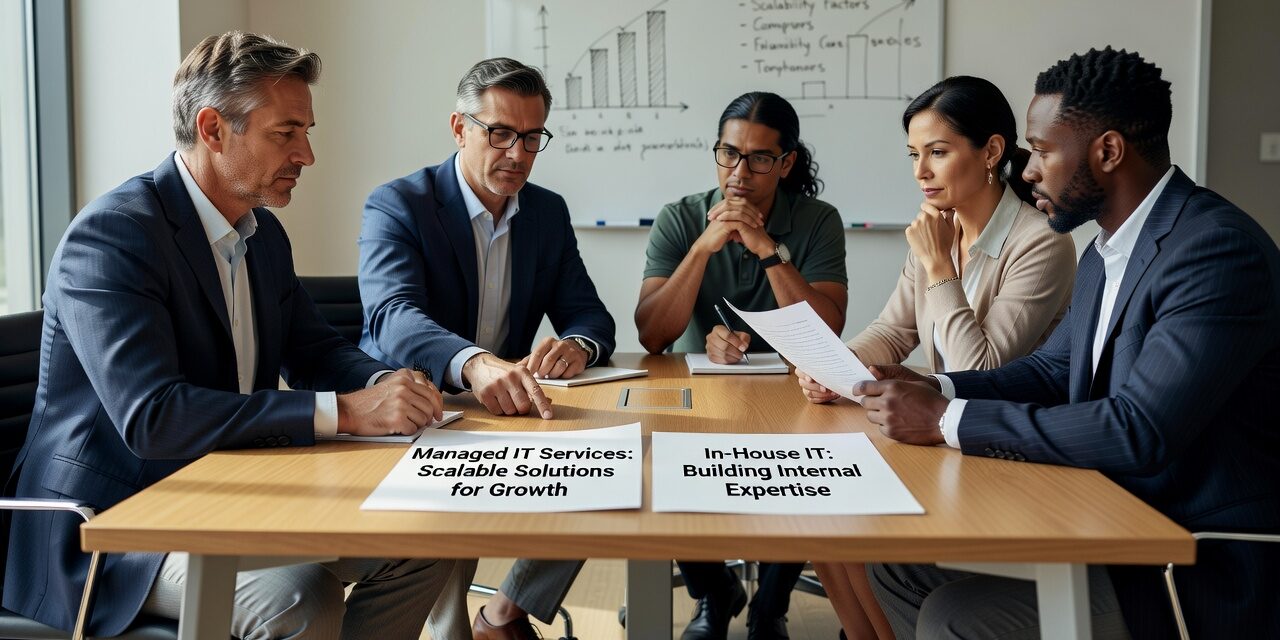
At this stage, most business owners face a crucial choice: build an internal IT department or partner with managed IT services. The decision affects not just your technology costs, but how quickly you can grow, how well you handle security threats, and how much time leadership spends on IT problems instead of business strategy.
Cost Reality: Beyond the Monthly Bills
The sticker price comparison often favors managed IT services, but the real cost difference runs deeper than monthly fees versus salaries.
Managed IT services typically cost $100 to $200 per user per month, covering help desk support, monitoring, security tools, backups, and system maintenance. For a 40-person company, that’s $4,000 to $8,000 monthly with predictable billing.
In-house IT requires at least one full-time technician ($50,000 to $70,000 salary) plus benefits, training, and coverage for vacations and sick days. Add monitoring software, security tools, backup systems, and help desk software, and you’re looking at $80,000 to $100,000 annually before considering the need for additional staff as you grow.
The hidden costs hit harder with in-house teams. When your IT person takes vacation, problems wait. When they leave for another job, you’re scrambling to maintain systems you might not fully understand. Most growing businesses discover they need at least two IT people to avoid single points of failure.
Capability Gaps That Matter to Daily Operations
The expertise difference between managed services and typical small business IT hires shows up in three critical areas.
24/7 monitoring and response is nearly impossible to achieve with in-house staff. Managed IT providers monitor systems around the clock, catching server issues, security threats, and network problems before they affect your team’s work. Your internal IT person, no matter how dedicated, can’t watch systems at 2 AM on a Sunday.
Specialized security knowledge has become essential as cyber threats target smaller businesses. Managed services bring dedicated security specialists who stay current on threat patterns, compliance requirements, and security tool management. An in-house generalist simply can’t match this depth while also handling day-to-day support requests.
Scalability support affects how quickly you can open new locations, onboard new employees, or implement new software. Managed services scale their support as you grow. In-house teams hit capacity limits and create bottlenecks during expansion periods.
When In-House IT Makes Sense
Despite the cost and capability advantages of managed services, some situations favor building internal IT teams.
Heavy on-site requirements make in-house staff essential. Manufacturing companies with specialized equipment, healthcare practices with complex medical devices, or businesses with unique hardware setups need immediate hands-on support that remote technicians can’t provide.
Highly specialized industry software sometimes requires internal expertise. If your core business systems need constant customization or integration work, an in-house team that understands both your technology and your business processes can be more effective than external technicians learning your setup.
Large enough to support multiple IT roles changes the cost equation. Once you reach 150 to 200 employees, you can justify dedicated specialists for different areas: help desk support, network administration, and security management. At this scale, in-house teams become more cost-competitive with managed services.
The Hybrid Approach: Best of Both Models
Many growing businesses find success with co-managed IT, combining internal staff with managed services. This model addresses the most common pain points of both approaches.
Your internal IT manager handles strategic planning, vendor relationships, and high-touch user support. They understand your business priorities and can make quick decisions about technology investments. Meanwhile, the managed service provider covers 24/7 monitoring, security management, backup systems, and overflow help desk support.
This arrangement costs more than pure managed services but less than building a full internal team. More importantly, it gives you both the business-specific knowledge of internal staff and the specialized capabilities of managed services.
Making the Decision: Questions That Matter
Three key factors should drive your choice between managed IT services vs in house IT support.
How fast are you growing? Rapid growth favors managed services because they can scale support quickly. If you’re adding 10 to 20 employees per year or opening new locations, managed services adapt faster than hiring and training internal staff.
What’s your risk tolerance for IT problems? Businesses that can’t afford significant downtime need the redundancy and expertise that managed services provide. If a four-hour email outage would seriously damage your operations, 24/7 monitoring and support become essential.
Where does IT fit in your competitive strategy? Companies that compete on technology innovation might justify heavy internal IT investment. But if technology simply needs to work reliably so you can focus on customers, operations, or product development, managed services often make more strategic sense.
What This Means for Your Business
The managed IT services vs in house IT decision isn’t just about cost control—it’s about positioning your business for sustainable growth. Most companies between 25 and 150 employees get better results with managed services or a hybrid model, freeing leadership to focus on core business priorities while ensuring reliable, secure technology operations.
The key is honest assessment of your current capabilities, growth trajectory, and risk tolerance. If you’re spending too much time on IT problems instead of business development, or if your current IT support can’t keep pace with your growth, it’s time to explore managed services options.
Need help evaluating IT support strategies for your growing business? TECHZN provides comprehensive managed IT support for growing businesses that scales with your needs while keeping technology costs predictable. Contact us to discuss how the right IT approach can support your business growth.