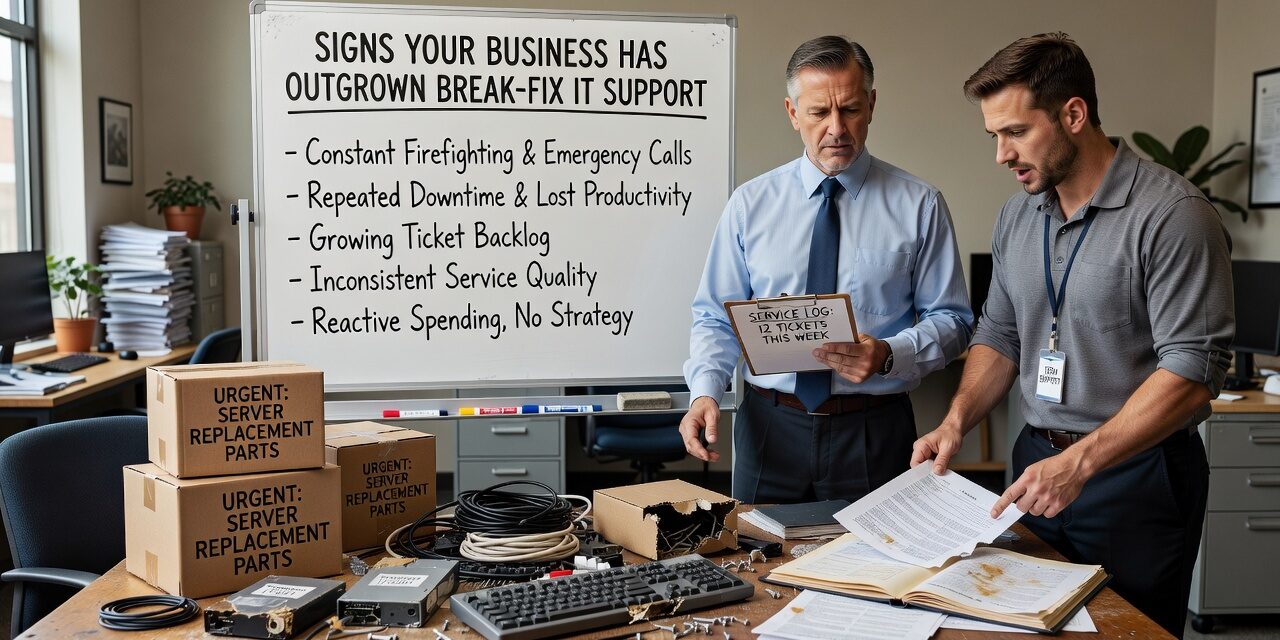
At some point, calling someone when things break stops being a strategy. If your team is losing hours to recurring outages, waiting days for a response on a simple issue, or piecing together IT support from three different vendors with no clear owner, that is not a support model—it is a liability.
Break-fix IT made sense when your operation was smaller and technology was simpler. But as your business grows, the signs that you have outgrown break-fix IT support tend to multiply quietly, until one bad week makes them impossible to ignore.
Here is how to recognize where you are—and what it actually costs you to stay there.
The Break-Fix Model Works Until It Doesn’t
Break-fix support is exactly what it sounds like: something breaks, you call someone, they fix it, you pay per incident. For a very small office with basic needs, this can work reasonably well. The problem is that break-fix is reactive by design. There is no monitoring, no planning, and no one accountable for keeping things stable.
When your team was five people sharing a single server and a basic internet connection, a few outages a year were manageable. When your team is twenty-five people running cloud applications, processing payments, and relying on Microsoft 365 for every internal workflow, a few outages a year is a serious operational problem.
The model does not scale—and most businesses do not notice until something goes badly wrong.
Common Signs You Have Already Outgrown It
The same problems keep coming back. This is one of the clearest signals. If your internet drops every few weeks, if Outlook keeps misbehaving for certain users, or if your VPN causes problems every time someone works remotely, those are not random bad luck events. They are symptoms of issues that were patched instead of resolved. Break-fix providers fix what is visible. They rarely have time to find the root cause.
You have no idea what is actually running on your network. If someone asked you right now which devices are connected to your office network, which software is outdated, or whether your backups ran last night—could you answer? Most businesses running on break-fix support cannot. There is no ongoing monitoring, no asset inventory, and no documentation. That blind spot creates real security and continuity risk.
Your IT costs are unpredictable month to month. Break-fix billing can look affordable on paper until you have a bad quarter. One server failure, one ransomware cleanup, one network rebuild after a bad configuration—these bills arrive without warning. Budgeting for technology becomes guesswork.
Staff productivity is quietly suffering. Think about the last time a team member spent an afternoon working around a tech problem instead of fixing it. Or the last time a small IT issue sat unresolved for a week because no one was sure who to call. These slowdowns rarely show up as a single dramatic event. They accumulate.
You recently moved offices, added a location, or grew your headcount significantly. Office moves are one of the most common moments where break-fix arrangements completely fall apart. Internet, phones, printers, file access, and user accounts all need coordinated planning. A vendor who shows up when called is not positioned to handle that kind of project with any reliability.
The Blind Spot Most Business Leaders Miss
The most common mistake at this stage is assuming the problem is the specific vendor, not the model.
Businesses switch break-fix providers hoping the next one will be faster, more responsive, or more proactive. And sometimes the new vendor is better—for a while. But if the underlying arrangement is still reactive and unmonitored, the same patterns return. Recurring issues. Slow response. No visibility. No planning.
The real shift is not finding a better break-fix vendor. It is moving from a reactive model to one where someone is actively responsible for the health of your systems before things fail.
What Changes When You Move to a Managed Model
Managed IT support operates on a fundamentally different logic. Instead of waiting for a call, a managed provider monitors your environment continuously, handles patching and updates on a schedule, and owns accountability for keeping things running.
From a day-to-day operations standpoint, this changes several things:
- Employees have a consistent place to report problems, usually a help desk with defined response times rather than a personal cell number.
- Recurring issues get documented and addressed at the root, rather than patched and forgotten.
- You get a predictable monthly cost, which makes technology budgeting straightforward.
- Security is maintained proactively—software stays updated, backup jobs are monitored, and someone is watching for unusual activity.
For growing businesses, especially those running multiple cloud applications or handling sensitive customer data, this kind of structure is not a luxury. It is basic operational hygiene.
If you are evaluating options, look for providers who can explain clearly what they monitor, how they handle escalations, and what your realistic response time will be for different types of issues. If a provider cannot answer those questions specifically, keep looking. For businesses in Texas evaluating their options, managed IT support for growing businesses typically includes defined SLAs, proactive monitoring, and a dedicated help desk—none of which exist in a break-fix arrangement.
Practical Questions to Help You Decide
If you are not sure whether you have outgrown break-fix support, these questions can help clarify where you stand:
- How many IT-related interruptions did your team experience in the last 90 days?
- Do you have documentation of what software, hardware, and user accounts exist in your environment?
- Do you know whether your backups ran successfully this week?
- If your primary server or cloud system failed tomorrow, how long would it take to recover—and does anyone actually know the answer?
- When a staff member has a tech problem, do they know exactly who to contact and what to expect?
If several of these are hard to answer, that is useful information. It does not mean something is broken today. It means the risk is higher than it needs to be, and the cost of a bad event is higher than it would be with proper support in place.
What This Means for Your Business
Break-fix IT is not a failure—it is a starting point. But it has a ceiling, and most growing businesses hit that ceiling faster than they expect. The warning signs are usually visible well before the serious problems arrive: recurring issues, unpredictable costs, staff workarounds, and no real visibility into what is running.
If these patterns sound familiar, the question is not whether to make a change. It is how to make the right one.
TECHZN works with businesses in Dallas and Austin that are ready to move beyond reactive IT support. If you want a straightforward conversation about what a managed approach would look like for your operation, reach out to our team to get started.