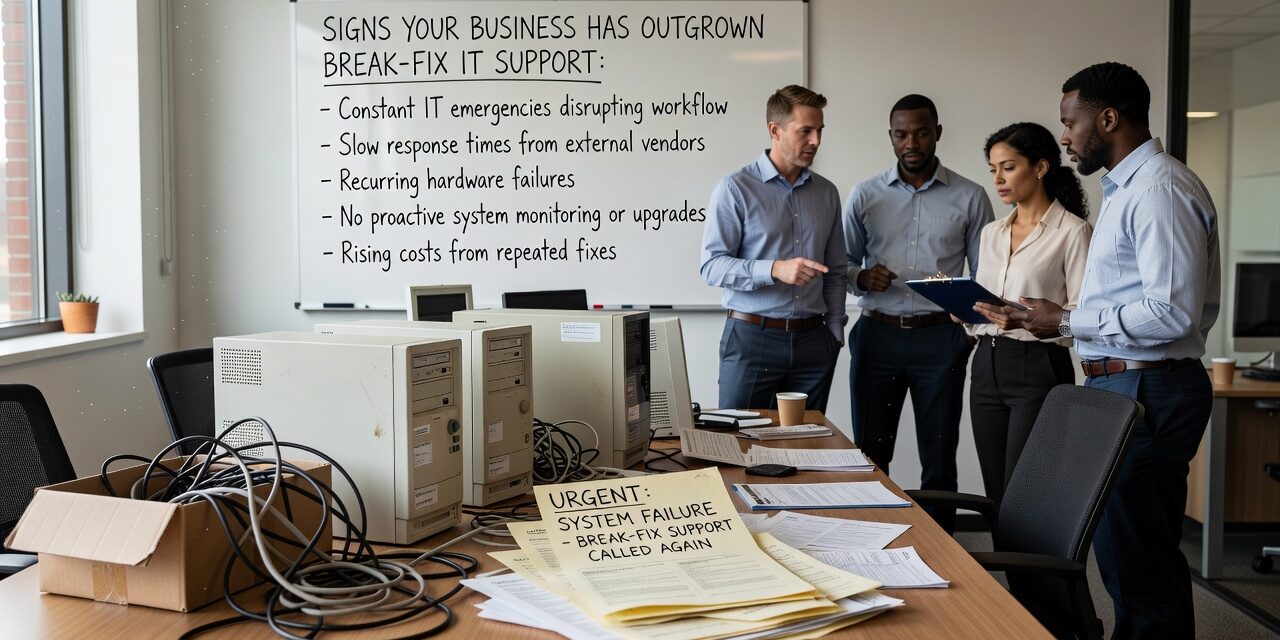
At some point, calling a contact to fix things when they break stops working. Not because the person isn’t capable, but because your business has grown past what reactive IT support can handle. Recognizing the signs your business has outgrown break-fix IT support early can save you from a slow drain on productivity, staff patience, and operational stability.
Break-fix is simple by design: something goes wrong, you call someone, they fix it, you pay. For a five-person office with basic needs, that can work fine. But once your headcount grows, your systems get more interconnected, and your clients expect reliable service delivery, that model starts costing more than it saves.
The Same Problems Keep Coming Back
One of the clearest indicators that break-fix has run its course is the pattern of recurring problems. If your team is filing the same types of tickets—slow internet, Microsoft 365 login issues, printers dropping off the network, backup errors—and those problems keep returning a few weeks later, something is wrong at a structural level.
Break-fix providers solve the immediate symptom. They don’t typically investigate root causes, document what they found, or flag patterns across your environment. That’s not a criticism—it’s just not what the model is built for. But it means your business absorbs repeated disruptions without anyone actually fixing the underlying issue.
A realistic example: a 40-person professional services firm experiences email sync problems across the team every few weeks. Each time, someone calls their IT contact, waits a few hours for a response, and gets a temporary fix. Nobody ever looks at whether the Microsoft 365 tenant configuration is the root cause. That’s a break-fix blind spot.
Response Times Are Hurting Productivity
When IT support is informal or reactive, response times are unpredictable. Your IT contact might respond in 20 minutes—or they might be on another job, unavailable, or on vacation. For a growing business, that unpredictability has a real cost.
Think about what happens when a staff member can’t access a key system for two hours. That’s not just an annoyance. Depending on the role, it could mean a delayed client deliverable, a missed deadline, or a frustrated customer. Multiply that across multiple employees and recurring incidents, and the productivity loss adds up fast.
Break-fix doesn’t come with service level agreements. There’s typically no commitment to respond within a defined window, no escalation path if the first call doesn’t resolve the issue, and no visibility into how long problems actually take to close. If your business relies on technology to operate—and nearly every business does—that level of unpredictability is a liability.
Your IT Environment Is Getting More Complex
Break-fix made sense when your IT environment was simple. A few laptops, a shared drive, maybe a basic router. But as businesses grow, the environment grows with them—and it grows in ways that aren’t always obvious.
You might now have:
- Remote and hybrid staff accessing systems from multiple locations
- Cloud applications from several vendors with overlapping functions
- Microsoft 365 with SharePoint, Teams, and OneDrive all in active use
- A mix of old on-premise hardware and newer cloud services
- Vendors and contractors who need occasional access to your systems
Each of those elements introduces potential failure points and security considerations. Break-fix support handles them in isolation, after something fails. What it doesn’t do is monitor your environment proactively, flag misconfigurations before they become incidents, or make sure your security settings still make sense as the team grows.
This is a common blind spot: business owners often don’t realize how much their IT environment has changed until something goes seriously wrong. An annual IT health review would catch most of these gaps—but break-fix providers aren’t structured to provide that kind of ongoing oversight.
You’re Carrying More Risk Than You Realize
Here’s where the break-fix model becomes a genuine business risk, not just an inconvenience.
Backups are a good example. Many businesses on break-fix arrangements have backups configured at some point in the past—but nobody has tested them recently. Nobody has verified that the right data is being captured, that recovery actually works, or that retention settings still match the business’s needs. If a ransomware incident or hardware failure occurs, that’s when the backup gaps get discovered. That’s too late.
The same applies to user access. When an employee leaves, are their accounts being disabled promptly? Are former contractors still able to reach your cloud systems? Break-fix support doesn’t typically include the kind of regular access reviews that catch these issues before they become security incidents.
For businesses working with clients in regulated industries—healthcare, finance, legal—this risk exposure can also create compliance problems. The documentation and audit trails that regulators and cyber insurance underwriters expect don’t come from a break-fix arrangement.
You’re Managing Too Many IT Relationships
Another sign the model has been stretched too thin: you’re now managing three or four different IT contacts, and none of them have a full picture of your environment.
One person handles the firewall. Another handles the computers. A third manages your phone system. And when something breaks at the intersection of those systems—which is usually when the worst outages happen—nobody owns the problem. Each vendor points to the others, and your staff waits while the finger-pointing plays out.
That coordination gap is one of the hidden costs of break-fix IT that doesn’t show up on any invoice. It shows up in staff frustration, in delayed resolution times, and in the amount of time your office manager or operations lead spends acting as an IT coordinator.
What This Means for Your Business
If several of these signs sound familiar, break-fix IT isn’t a cost-saving measure anymore—it’s a cost center with unpredictable expenses and growing risk.
The transition to a managed IT model isn’t just about getting faster support. It’s about having someone accountable for your environment on an ongoing basis: monitoring it, documenting it, flagging problems before they become outages, and making sure your security posture keeps pace with how your business actually operates.
For businesses in Texas looking for structured managed IT support for growing businesses, TECHZN works with companies across Dallas and Austin to replace reactive IT chaos with a predictable, accountable support model. If you’re not sure whether your current setup is keeping up, that conversation is a reasonable place to start.