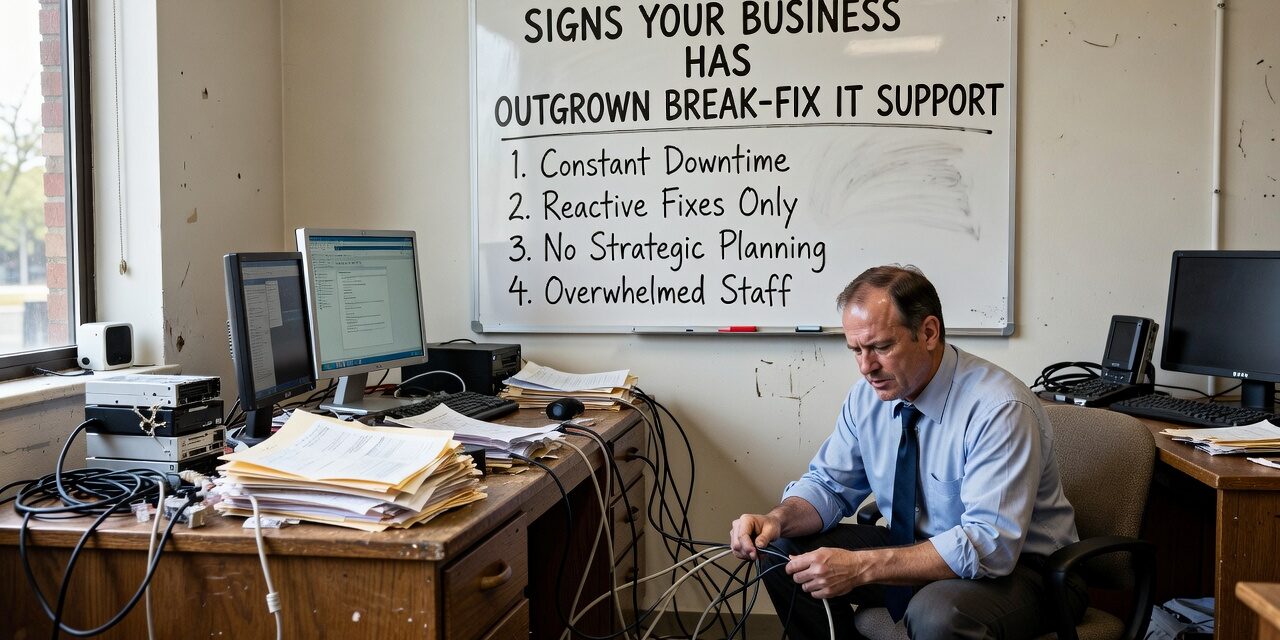
At some point, calling your IT guy when something breaks stops being a workable strategy. It might have been fine when your team was small, your systems were simple, and a few hours of downtime didn’t cost much. But when your business grows—more staff, more locations, more software, more customers depending on your operations—break-fix support starts showing its limits in very specific, expensive ways.
Here are the signs your business has outgrown break-fix IT support, and what it usually costs to ignore them.
Your Team Keeps Losing Time to the Same Problems
One of the clearest signals is repetition. If your staff is opening tickets for the same issues week after week—slow Wi-Fi in a particular part of the office, Microsoft 365 login failures, a printer that keeps dropping off the network—that’s not bad luck. It’s a symptom of a support model that fixes symptoms without addressing causes.
Break-fix IT is inherently reactive. A technician shows up, resolves the visible problem, and closes the ticket. There’s no financial incentive under that model to dig into why the problem keeps happening or to monitor systems before they fail. For a five-person office, that might be acceptable. For a 30- or 50-person team where every hour of slowdown has real operational cost, it adds up quickly.
Ask yourself: Over the past six months, how many of your IT issues were genuinely new problems versus the same ones resurfacing?
You Have No Clear Answer for What Happens When Something Goes Wrong
Break-fix arrangements tend to be informal. You call a number, leave a message, and wait. There’s often no agreed-upon response time, no escalation path, and no documented process for what happens if a server goes down at 7 AM on a Monday before a big client meeting.
This becomes a serious problem as your operations get more complex. Consider a few scenarios that come up regularly:
- A multi-location office loses internet connectivity at one site. Nobody knows who to call or whether the issue is the ISP, the router, or something else entirely.
- A departing employee’s accounts aren’t disabled promptly, leaving active credentials tied to critical systems for days.
- A backup failure goes undetected for weeks—only discovered when someone tries to restore a lost file.
None of these require a catastrophic failure to cause real damage. They’re ordinary operational gaps that break-fix support isn’t structured to catch. If your current IT arrangement doesn’t include proactive monitoring, documented procedures, and a clear point of contact with accountability, you’re relying on luck more than you probably realize.
Your IT Costs Are Unpredictable and Trending Up
Break-fix IT feels cheaper because you’re only paying when something breaks. But that math changes as your environment grows.
More devices, more users, and more software integrations mean more surface area for problems. A growing company running on break-fix support often finds that their IT bills spike unpredictably—a bad month can cost three or four times a typical month with no warning. That makes budgeting difficult and creates pressure to delay necessary fixes to manage costs.
There’s also a subtler cost that rarely shows up in any invoice: the internal time your staff and managers spend dealing with IT problems. When an office manager is spending an hour troubleshooting a network issue because the IT vendor hasn’t called back, that’s not free. It’s just invisible.
A common mistake at this stage is treating IT support purely as an expense line to minimize rather than as infrastructure that directly affects how reliably your business operates.
You’re Making Technology Decisions Without Any Planning Guidance
Break-fix vendors fix things. They’re generally not in a position—or paid—to help you think through whether your current setup will handle growth, whether your Microsoft 365 configuration is exposing data, or whether your backup solution actually meets your recovery needs.
This is where many growing businesses quietly accumulate risk. Software gets added without security review. New staff get admin access because it’s easier than configuring proper permissions. A cloud migration happens without anyone mapping out how existing systems will integrate.
By the time a problem surfaces, it’s often been building for months. The business owner or operations manager usually doesn’t find out until something breaks badly enough to be impossible to ignore.
If nobody on your current IT support arrangement is talking to you about planning, vendor management, or risk—not just fixing tickets—that’s a meaningful gap. Growing businesses need both reliable day-to-day support and someone thinking about where the technology needs to be in 12 to 24 months.
Your Business Has Changed, But Your IT Support Model Hasn’t
This is the clearest sign of all: your business has grown, added locations, taken on new compliance requirements, or expanded into new markets—and your IT support still looks exactly like it did three years ago.
Break-fix arrangements don’t scale. They don’t adjust to your risk profile, your growth pace, or the increasing complexity of keeping a modern business running. They respond to problems; they don’t grow with you.
If you’ve added more than a handful of employees, expanded to a second location, moved systems to the cloud, or started handling more sensitive customer or financial data, the support model that worked before is likely running past its limits.
What This Means for Your Business
Outgrowing break-fix IT isn’t a criticism of the vendor or the model—it’s just a reality of business growth. At a certain point, reactive support creates more risk and more cost than it saves.
The shift to proactive, managed IT support typically means getting ahead of issues before they cause downtime, having clear accountability and response expectations, and having someone helping you plan rather than just repair.
If several of the signs above sound familiar, it’s worth having a direct conversation about how your current support model is actually serving your operations—and whether there’s a better structure for where your business is now.
TECHZN works with growing businesses in Dallas and Austin to move from reactive IT firefighting to a structured support model that fits their size and goals. If you’re not sure whether your current setup is keeping up, reach out to our team for a straightforward conversation about managed IT support for growing businesses.