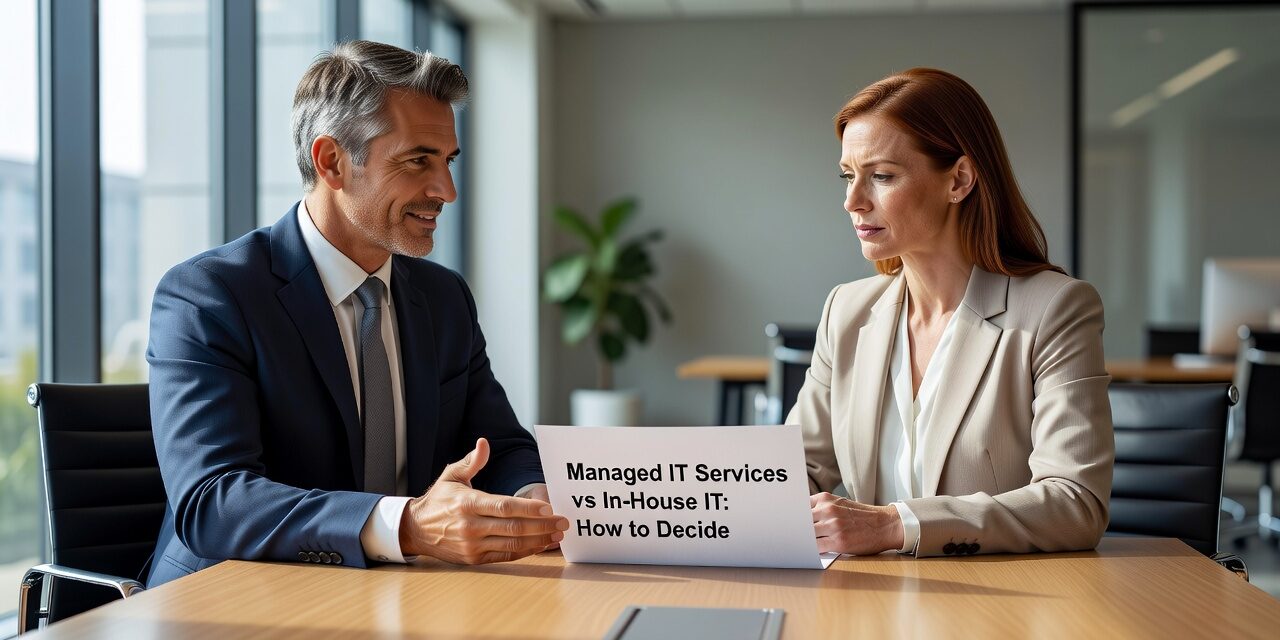
Choosing between managed IT services vs in-house IT is one of the more consequential decisions a growing business can make — and most owners don’t realize how much it affects day-to-day operations until something goes wrong. This isn’t about which option sounds better. It’s about which one actually fits how your business runs, what you need covered, and what you can realistically afford to manage internally.
Here’s a practical breakdown to help you think it through.
What You’re Actually Comparing
An in-house IT setup typically means one or more employees dedicated to managing your technology. They handle help desk requests, keep systems running, deal with vendors, and take on any projects that come up. For some businesses, this works well — especially when technology is central to the product itself or when regulatory complexity demands dedicated internal oversight.
Managed IT services work differently. A third-party provider takes on responsibility for your infrastructure, monitoring, security, support, and planning under a fixed monthly agreement. Your staff calls or submits a ticket when something breaks, but the provider is also watching systems around the clock, handling patches and updates, and flagging problems before they turn into outages.
The important distinction isn’t just cost. It’s coverage, consistency, and what happens when your single IT person takes a vacation — or quits.
Where In-House IT Tends to Fall Short
This isn’t a criticism of IT employees. It’s a structural reality.
A single internal IT hire typically covers the basics: resetting passwords, setting up new workstations, handling printer problems, and responding to whatever lands in their inbox. What that person usually can’t cover adequately — through no fault of their own — is 24/7 monitoring, after-hours response, security operations, and long-term infrastructure planning, all at the same time.
Consider a common scenario: a law firm with 25 employees hires an IT coordinator. That person is capable and responsive during business hours. But a critical file server starts throwing disk errors at 11 p.m. on a Tuesday. No one sees it until staff arrive Wednesday morning to find files inaccessible. The coordinator scrambles. Billable hours are lost. Clients are affected.
That’s not a hiring problem. It’s a coverage gap. No single person can maintain enterprise-level monitoring, response, and planning while also handling day-to-day tickets.
Another common blind spot: when an in-house IT person manages everything — passwords, vendor accounts, firewall access, cloud licenses — and then leaves the company. Businesses regularly discover that critical credentials weren’t documented, vendor relationships were entirely informal, and no one else knows how anything is set up. The offboarding of an IT employee can create more disruption than any system failure.
Where Managed IT Services Can Create Real Operational Value
For businesses that don’t have deep internal IT resources, a managed services model addresses several problems that internal hires typically can’t.
Consistent monitoring and proactive maintenance. Rather than waiting for staff to report a slow system or a login issue, a managed provider watches infrastructure in real time. Disk capacity warnings, failed backup alerts, and unusual network activity get flagged before users notice anything. For a business running multiple locations, this kind of coverage is difficult to replicate with internal staff.
Predictable costs. Break-fix IT — where you call someone only when something breaks — comes with unpredictable bills and no incentive for the vendor to prevent problems. A managed services agreement aligns your provider’s interests with yours: fewer incidents mean less work for them, so the motivation to stay ahead of problems is built into the model.
Broader skill coverage. One internal hire might know networking but have limited experience with cloud migrations or cybersecurity hardening. A managed services team typically includes specialists across disciplines — help desk, network, security, cloud — without requiring you to hire and manage each of them separately.
For example, a growing accounting firm preparing to migrate from an on-premises file server to Microsoft 365 would need someone who understands data mapping, user permissions, email migration, and training rollout. That’s a project requiring multiple skill sets. An internal generalist can often struggle with scope like that without additional outside help anyway.
The Honest Cases Where In-House IT Makes More Sense
Managed IT services aren’t the right fit for every organization. There are legitimate reasons to keep IT internal.
If your business is large enough to have a full IT department — not just one person — internal teams can provide deep institutional knowledge, faster on-site response, and tighter control over proprietary systems. Enterprise organizations with compliance-intensive environments sometimes require dedicated staff who understand the business deeply.
Some industries also have data handling requirements that make third-party access to systems complicated, though most reputable managed providers have well-documented processes for handling regulated environments.
The tipping point most small and mid-sized businesses face is this: they’ve grown past what one IT person can handle, but they’re not large enough to justify a full internal team. That’s where outsourced support options often deliver the most value.
Common Mistakes When Making This Decision
The biggest mistake businesses make is evaluating IT support purely on hourly rate or monthly cost without accounting for what’s not covered.
A cheaper break-fix arrangement might look attractive until you calculate what two days of downtime actually costs in lost productivity, missed deadlines, and staff frustration. A managed services agreement with proactive monitoring and a defined response time isn’t just a service — it’s a hedge against those costs.
Another mistake: assuming a managed provider replaces the need for any internal ownership. Someone inside your business still needs to understand what systems you use, make decisions about technology investments, and communicate with the provider about operational changes. The provider handles the technical work. The internal contact keeps them informed and aligned with the business.
Finally, businesses often make this decision in a vacuum — without auditing what they currently have. Before switching models, it’s worth reviewing your ticket history, recurring issues, after-hours incidents, upcoming projects, and any gaps in documentation. That audit often reveals whether your current setup is actually working or just appearing to work.
What This Means for Your Business
There’s no universal right answer here, but there is a practical framework. If your business relies on technology to operate, has more than 10 to 15 employees, and lacks after-hours coverage or consistent monitoring, the gaps in an internal-only model are real and worth addressing.
If you’re trying to figure out whether your current IT support is keeping up — or evaluating what a managed services model would actually look like for your operation — TECHZN offers managed IT support for growing businesses across Dallas and Austin. The conversation starts with understanding your environment, not selling a package.
Reach out to TECHZN to talk through what your business actually needs.