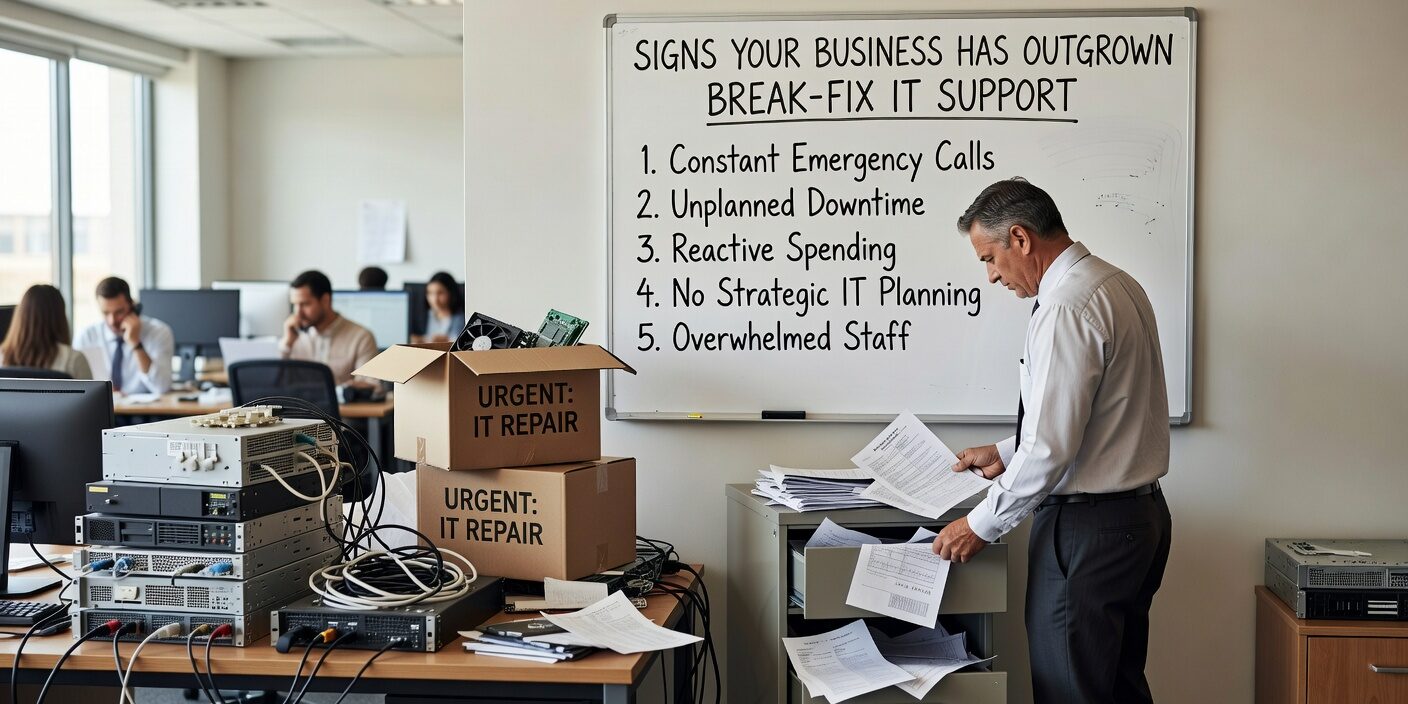
When your business was smaller, calling an IT technician only when something broke probably made perfect sense. Break-fix IT support worked fine for basic setups with fewer moving parts. But as companies grow, this reactive approach often becomes a liability rather than a solution.
Recognizing the signs your business has outgrown break-fix IT support helps you make the transition to proactive IT management before recurring problems start affecting your bottom line. Here’s what to watch for and when it’s time to consider a different approach.
Frequent Downtime Is Disrupting Operations
One of the clearest indicators you’ve outgrown reactive IT support is when system problems become routine rather than exceptional. Your business likely needs more comprehensive support when:
- Systems crash or slow down multiple times per week
- Staff regularly work around IT problems instead of having them properly resolved
- The same issues keep returning because only symptoms get patched, not root causes
- Productivity suffers as employees lose time to technology frustrations
Break-fix support addresses problems after they occur, but it doesn’t prevent them. If IT disruptions are affecting your team’s work more than a few times per month, you’re already paying for downtime in lost productivity and missed opportunities.
Proactive IT monitoring and maintenance can identify potential problems before they cause outages. This shift from reactive to preventive support typically reduces both downtime and the stress that comes with unexpected system failures.
IT Costs Have Become Unpredictable
Another major sign your business has outgrown break-fix support is when IT expenses become impossible to budget accurately. This typically shows up as:
- Wild swings in monthly IT costs – nothing one month, then a large emergency bill the next
- Surprise invoices that impact cash flow or delay other business investments
- Leadership struggling to forecast IT expenses for budgeting purposes
- Emergency repairs that cost significantly more than planned maintenance would have
When you can’t predict your IT spending, it becomes difficult to make informed business decisions. A server crash, ransomware incident, or major hardware failure can generate unexpected costs that strain your budget and force you to delay other important initiatives.
Many businesses find that switching to a predictable monthly IT service fee actually reduces their total technology costs while providing better support and preventing expensive emergencies.
Security Risks Are Growing
Modern cybersecurity threats make “fix it when it breaks” approach increasingly risky. Your business has likely outgrown break-fix IT support if:
- You have no continuous security monitoring or threat detection
- Cybersecurity discussions only happen after an incident occurs
- Software updates and security patches are applied inconsistently
- You’re unsure how quickly your business could recover from a cyber attack
Small and midsize businesses are increasingly targeted by cybercriminals because they often have valuable data but fewer security resources than larger companies. Reactive IT support typically can’t provide the 24/7 monitoring and proactive threat prevention that modern security requires.
If your business handles sensitive information – customer data, financial records, health information, or intellectual property – waiting until after a security breach to address cybersecurity is no longer a viable strategy.
Response Times Don’t Match Business Needs
Break-fix support often means accepting whatever response time your technician can provide, which may not align with your business requirements. Consider whether your current approach is adequate when:
- Critical system outages leave you waiting hours or days for help
- You have no guaranteed response times or service level agreements
- Customer-facing systems go down with no clear escalation path
- Revenue-generating activities stop while you wait for IT support
If a serious outage can halt sales, prevent customer service, or stop production for more than a few hours, you need guaranteed response times and clear escalation procedures. These service commitments are standard features of most comprehensive IT support agreements.
Growth Has Increased IT Complexity
Many businesses outgrow break-fix support simply because their technology environment becomes more complex as they grow. Common indicators include:
- Team size beyond 10-15 employees, creating more devices and potential issues
- Multiple office locations or remote workers requiring consistent IT standards
- New software applications that need to integrate with existing systems
- Customer or vendor requirements for specific security or compliance standards
As your IT environment becomes more complex, the interconnected nature of modern technology means that small problems can quickly cascade into larger issues. What starts as a simple network slowdown can affect multiple applications and dozens of users.
This complexity requires proactive management and standardized procedures rather than ad-hoc repairs. Waiting for problems to occur becomes increasingly disruptive and expensive as your technology infrastructure grows.
No Strategic IT Planning
A significant sign you’ve outgrown reactive IT support is when technology decisions feel rushed and unplanned. This often appears as:
- Your IT provider “fixes and disappears” without offering guidance on improvements
- No technology roadmap aligned with your business growth plans
- Equipment purchases happening only after something fails completely
- Lack of input on how technology could better support your business goals
Effective IT management includes strategic planning, budgeting for technology lifecycle replacement, and aligning IT investments with business objectives. If your technology feels like it’s always playing catch-up to your business needs, you likely need more comprehensive support that includes planning and advisory services.
Employee Frustration Is Increasing
Your team’s daily experience with technology often provides clear insight into whether your current IT support approach is working. Warning signs include:
- Frequent complaints about slow systems, unreliable Wi-Fi, or connectivity problems
- Multiple support tickets for the same issue within a short timeframe
- Employees developing workarounds instead of getting problems properly resolved
- IT issues becoming a regular topic in team meetings or management discussions
When technology frustrations become part of your workplace culture, it’s typically a sign that reactive support isn’t keeping pace with your business needs. Proactive IT management focuses on preventing these daily irritations rather than just responding to them.
What This Means for Your Business
Recognizing these signs early allows you to make a strategic transition rather than being forced into emergency decisions during a crisis. If you’re experiencing multiple indicators from this list, it may be time to explore IT support strategy for small businesses that focuses on prevention rather than reaction.
The shift from break-fix to comprehensive IT support typically provides better cost predictability, improved security, reduced downtime, and strategic technology guidance. Most importantly, it allows your team to focus on growing your business rather than constantly managing technology problems.
Proactive IT support helps ensure your technology infrastructure can scale alongside your business growth, providing the reliability and security foundation that modern companies require to succeed.
Ready to explore proactive IT support options for your growing business? Contact TECHZN today to discuss how comprehensive IT management can reduce downtime, improve security, and provide the predictable technology foundation your business needs to thrive.