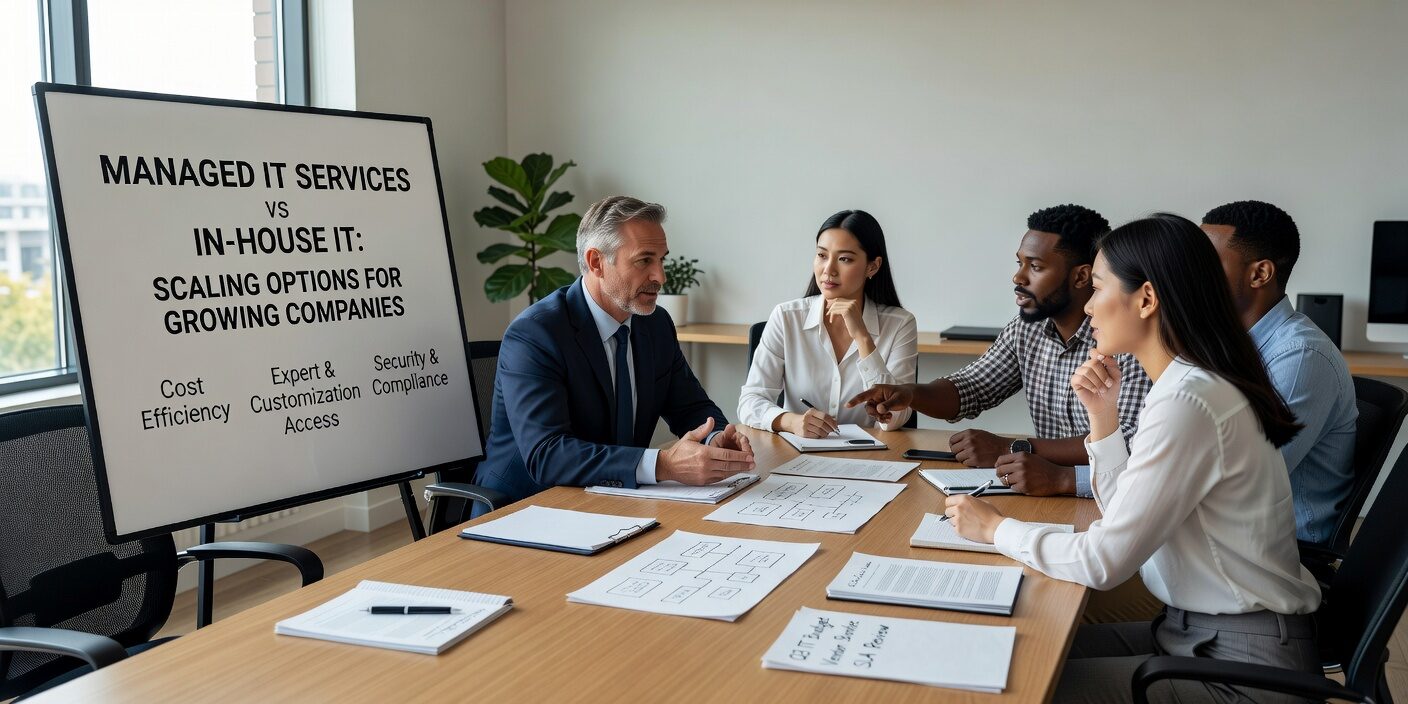
When your company is growing, every technology decision impacts your ability to scale efficiently. The choice between managed IT services vs in-house IT affects not just your budget, but your security, operational flexibility, and ability to focus on core business goals.
Most growing companies reach a point where basic break-fix support isn’t enough, but building a full internal IT department feels overwhelming. Understanding the practical differences between outsourced and internal IT support helps you make the right choice for your specific growth stage and business needs.
Cost Comparison: Predictable vs. Variable Expenses
Managed IT services typically offer predictable monthly costs that include support, monitoring, security tools, and maintenance. This approach eliminates surprise expenses from emergency repairs, software licensing, or urgent hardware replacements.
In-house IT requires salaries, benefits, training costs, equipment purchases, and ongoing software licensing. These expenses can fluctuate significantly based on:
- Staff turnover and recruitment costs
- Training requirements for new technologies
- Hardware refresh cycles
- Emergency repairs and downtime recovery
- Software licensing and compliance fees
For most growing companies, the total cost of ownership for internal IT exceeds managed services once you factor in all direct and indirect expenses. The break-even point usually occurs when companies reach sufficient size to fully utilize multiple full-time specialists.
Expertise and Skill Coverage
Managed providers bring teams of specialists covering cybersecurity, cloud management, network administration, help desk support, and compliance. This breadth of expertise is particularly valuable for growing companies that need diverse technical skills but cannot afford to hire multiple specialists.
Internal teams offer deep knowledge of your specific systems and business processes. They understand your unique workflows and can provide immediate, on-site support when needed.
The challenge with in-house IT is skill gaps. A single IT person or small team cannot realistically master:
- Advanced cybersecurity monitoring
- Cloud architecture and migration
- Compliance requirements across multiple frameworks
- Modern backup and disaster recovery
- Network security and monitoring
- Help desk best practices
Managed providers address these gaps by maintaining specialized teams for each area.
Scalability and Growth Support
Managed IT services scale quickly without major infrastructure investments or lengthy hiring processes. When you add locations, users, or new technology requirements, your provider can adjust support levels and resources immediately.
Internal IT scaling requires:
- Recruiting and onboarding new staff
- Expanding infrastructure and tooling
- Training existing team members on new technologies
- Managing larger teams and processes
For rapidly growing companies, this scaling lag can create operational bottlenecks and security vulnerabilities.
When Growth Demands Change
Growing companies often experience sudden changes in IT requirements:
- Office expansions requiring new network infrastructure
- Remote work policies needing secure access solutions
- New software integrations for operational efficiency
- Compliance requirements from new industry regulations
- Increased security threats as company visibility grows
Managed providers typically handle these transitions more smoothly because they have established processes and vendor relationships.
Security and Risk Management
Managed IT providers usually offer stronger security coverage for small and mid-sized companies through:
- 24/7 monitoring of networks and systems
- Proactive threat detection using advanced security tools
- Regular patch management across all systems
- Backup monitoring and disaster recovery testing
- Compliance support for industry-specific requirements
Internal teams can provide excellent security when properly staffed and equipped, but many growing companies struggle to maintain comprehensive coverage with limited resources.
The reality is that effective cybersecurity requires constant attention, specialized tools, and updated threat intelligence. Most internal IT teams focus primarily on daily operational support, leaving security as a secondary priority.
Common Security Gaps in Growing Companies
- Inconsistent patch management due to operational priorities
- Limited security monitoring outside business hours
- Inadequate backup testing and disaster recovery planning
- Delayed response to security alerts and incidents
- Insufficient staff training on emerging threats
Control and Responsiveness
In-house IT provides direct control over priorities, immediate access to support staff, and deep integration with business operations. When issues arise, internal teams can respond instantly without external coordination.
Managed providers require clear communication channels and service level agreements to ensure responsive support. Quality depends heavily on the provider’s processes, staffing, and commitment to your account.
For companies with highly specialized workflows or strict control requirements, internal IT may be necessary despite higher costs.
Making the Right Choice for Your Business
Consider managed IT services when:
- You want predictable monthly IT costs
- Your growth requires rapid scaling of IT support
- You need broader expertise than one or two people can provide
- Security and compliance are critical business requirements
- You prefer to focus internal resources on core business activities
Consider in-house IT when:
- You need constant on-site support for specialized systems
- Your operations require deep, proprietary technical knowledge
- You have sufficient budget for multiple full-time specialists
- Direct control over IT priorities is essential
- Your company is large enough to fully utilize internal resources
Hybrid Approaches
Some growing companies benefit from co-managed IT, where internal staff handle day-to-day support while managed providers cover specialized areas like security monitoring, cloud management, or after-hours support.
This approach can provide the best of both options when properly coordinated, though it requires clear division of responsibilities and good communication between teams.
What This Means for Your Business
The choice between managed IT services vs in-house IT ultimately depends on your growth trajectory, budget constraints, and operational requirements. Most growing companies find that managed services provide better value, security coverage, and scalability during periods of rapid change.
The key is selecting the right approach for your current needs while maintaining flexibility for future growth. Whether you choose managed services, internal IT, or a hybrid model, focus on providers or strategies that support your business goals rather than just technical requirements.
For companies experiencing rapid growth, managed IT support for growing businesses can provide the stability and expertise needed to scale efficiently while maintaining security and operational reliability.
Ready to evaluate your IT support options? Contact TECHZN to discuss how the right IT strategy can support your growth plans while reducing operational risk and ensuring business continuity.