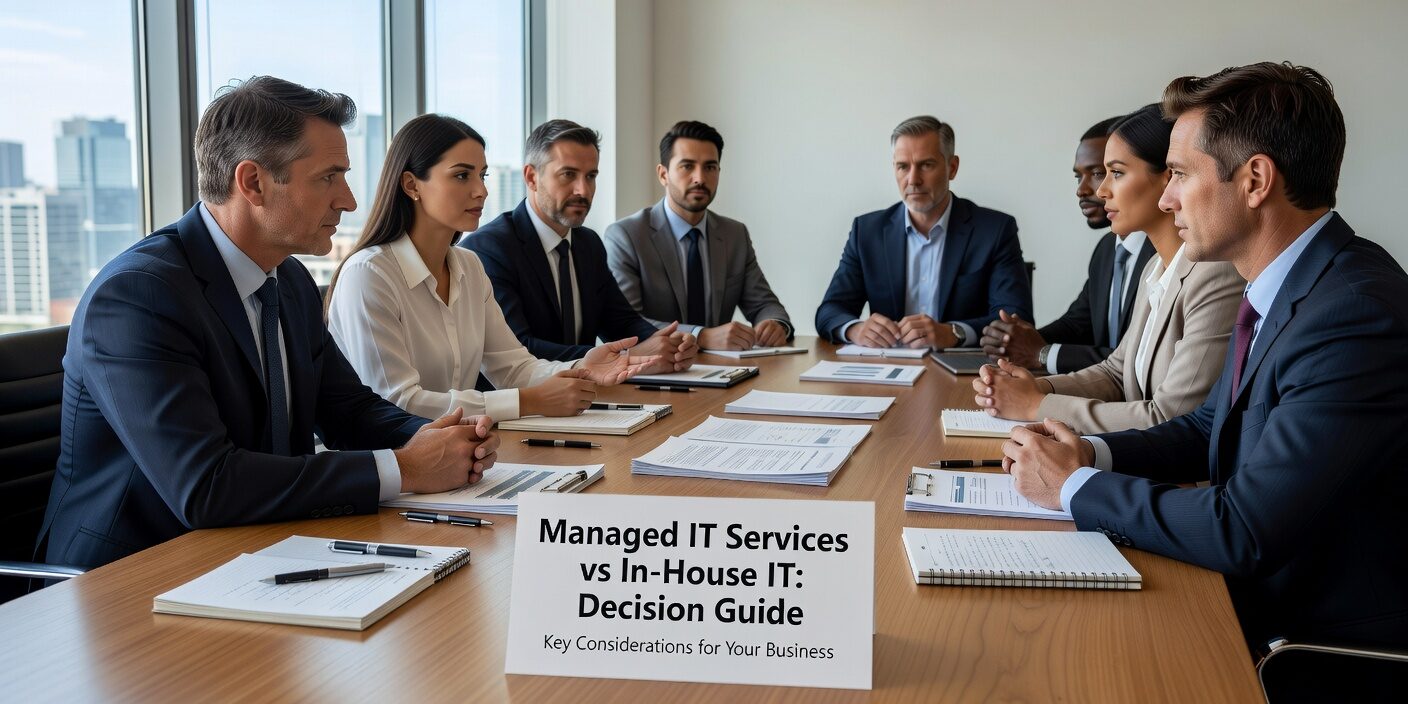
When your business reaches 20 employees or more, IT becomes too important to handle casually. The decision between managed IT services vs in house IT can make or break your technology budget and operational efficiency. Most growing companies underestimate the true cost difference by 30-40% once they factor in hidden expenses like training, tools, and downtime.
Cost Reality: What Each Option Actually Costs
For a growing business with 20-50 employees, the numbers tell a clear story. A single in-house IT generalist costs $8,000-$15,000 per month when you include salary, benefits, tools, and training. That translates to $96,000-$180,000 annually for your first IT hire.
Managed IT services typically run $2,500-$8,000 per month for the same employee range, including help desk support, monitoring, security tools, and backup services. The managed option often delivers more comprehensive coverage at a lower total cost.
Here’s what drives these cost differences:
- Training and certifications: In-house staff need $3,000-$8,000 annually in training costs. Managed service providers include this in their monthly fee
- Software tools: Remote monitoring, security software, and ticketing systems add thousands yearly. These come bundled with managed services
- After-hours coverage: Overtime pay or on-call premiums increase in-house costs. Managed providers include 24/7 monitoring in their standard pricing
- Downtime costs: A single IT person creates coverage gaps during vacations, sick days, or when they leave the company
When Managed IT Services Make the Most Sense
Managed IT services typically work best for companies experiencing steady growth with standard technology needs. If your business runs on common tools like Microsoft 365, cloud applications, and standard networking equipment, managed services deliver better value.
The advantages become clear during growth phases:
- Predictable monthly costs make budgeting easier and eliminate surprise expenses
- Team-based support means you get expertise in multiple areas rather than relying on one generalist
- 24/7 monitoring catches problems before they cause downtime
- Easy scaling lets you add or remove services as you grow without hiring cycles
- Better security coverage through enterprise-grade tools and dedicated security staff
Managed services also excel at handling compliance requirements. Whether you need SOC 2, HIPAA, or industry-specific standards, managed providers already have the processes and documentation frameworks in place.
The Sweet Spot for Managed Services
Most businesses between 20-100 employees find managed IT services provide the best combination of cost control and comprehensive coverage. You get enterprise-level capabilities without enterprise-level staffing costs.
When In-House IT Makes More Sense
Despite higher costs, in-house IT becomes more attractive as companies grow larger and develop specific needs that require constant attention.
In-house IT works best when you have 200+ employees and can fully utilize dedicated staff. At this scale, the per-employee cost of internal IT starts to make financial sense.
Other factors that favor in-house teams:
- Proprietary systems that require deep, ongoing customization
- Heavy on-site hardware like manufacturing equipment or specialized lab systems
- Complex integrations between multiple business systems that need constant fine-tuning
- Regulatory requirements that demand immediate, direct oversight
- Company culture that strongly values direct control over all operations
The Control Factor
In-house staff know your business intimately and can make decisions quickly without consulting external providers. This matters most when IT decisions directly impact daily operations or when you need someone who understands both your technology and business processes equally well.
The Hybrid Approach: Best of Both Worlds
Many growing companies find success with a hybrid model that combines internal leadership with external operational support. This approach typically emerges when businesses reach 50-200 employees.
A common hybrid structure includes:
- One internal IT manager who handles strategy and vendor relationships
- Managed services for help desk support, monitoring, and routine maintenance
- External specialists for projects like migrations or compliance initiatives
This model gives you internal advocacy and business alignment while maintaining cost-effective operational coverage. The internal person becomes your technology champion who works with managed IT support for growing businesses to ensure external providers understand your specific needs.
Key Decision Factors for Your Business
To make the right choice between managed IT services vs in house IT, evaluate these specific factors:
Growth trajectory: If you’re adding employees quickly or planning expansion, managed services scale more easily than hiring.
IT complexity: Standard business applications favor managed services. Unique, proprietary systems may need dedicated internal attention.
Budget structure: Managed services offer predictable monthly expenses. In-house hiring requires larger upfront commitments.
Risk tolerance: Single-person IT teams create coverage gaps. Managed services provide team-based redundancy.
Geographic spread: Multiple locations often benefit from centralized managed services rather than distributed internal staff.
Making Your Decision: A Practical Framework
Start by calculating your true current IT costs, including staff time spent on technology issues, consultant fees, software licenses, and estimated downtime expenses. Many businesses discover they’re already spending more than managed services would cost.
Next, get quotes from 2-3 managed service providers. Compare these against the full cost of hiring internal staff, including salary, benefits, training, and tools.
Consider your 2-3 year outlook. Will you double in size? Add locations? Face new compliance requirements? The option that fits today may not work as you grow.
Finally, think about what you want from IT support. If you need technology to “just work” reliably and cost-effectively, managed services usually deliver better results. If you want IT deeply integrated into business strategy and operations, internal staff may justify the higher investment.
What This Means for Your Business
The choice between managed IT services vs in house IT isn’t just about immediate costs. It’s about building technology support that enables growth while protecting your operations.
For most growing businesses under 100 employees, managed services provide better coverage at lower total cost. You get 24/7 monitoring, team-based support, and enterprise-grade security tools without the overhead of building an internal IT department.
Larger companies or those with specialized technology needs may find in-house staff worth the investment, especially when combined with managed services for specific functions.
The key is matching your IT support strategy to your business reality. Consider your growth plans, technology complexity, and budget constraints to choose the option that supports your success rather than limiting it.
Ready to explore how the right IT support model can improve your business operations? Contact TECHZN today for a comprehensive IT assessment and personalized recommendations for your growing company.