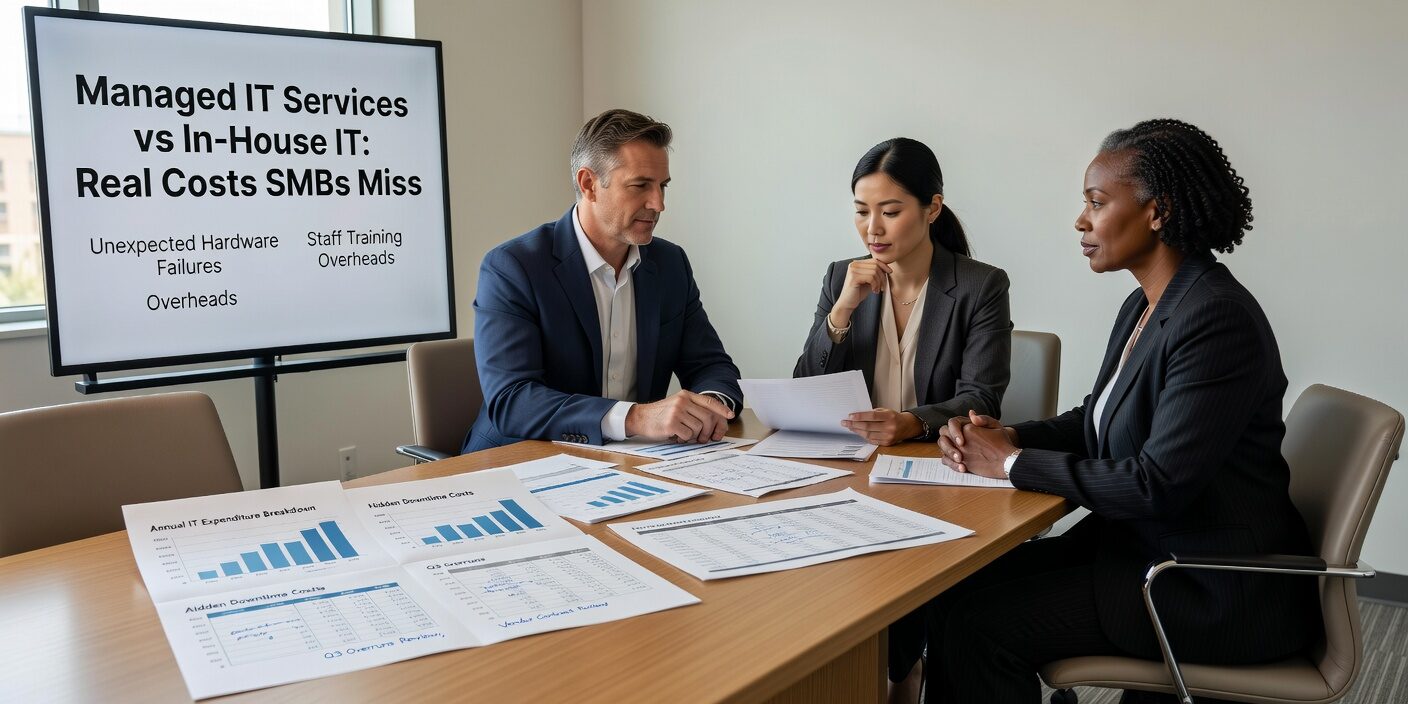
Choosing between managed IT services vs in house IT isn’t just about comparing salaries to monthly service fees. The real cost difference includes hidden expenses, coverage gaps, and business risks that most small business owners discover too late.
Many growing companies start with one “IT person” handling everything from password resets to network security. As the business expands, that approach creates bottlenecks, single-point failures, and surprisingly high total costs. Understanding the true comparison helps you make the right choice for sustainable growth.
The Hidden Costs of In-House IT Teams
Building an internal IT department looks straightforward on paper, but the real expenses add up quickly. A single IT professional earning $90,000 annually actually costs much more than their base salary.
Fully loaded employee costs include:
- Health insurance, retirement contributions, and payroll taxes (typically 25-40% above salary)
- Professional training and certifications to stay current
- Software licenses for monitoring, security, and management tools
- Vacation coverage and sick leave backup
- Recruitment costs when they leave
The total cost often exceeds $120,000 to $180,000 per year for a single IT employee. Small businesses typically need at least two people to cover basic help desk support plus infrastructure management, doubling these expenses.
Additional operational challenges:
- Limited expertise across all technology areas
- Difficulty scaling support during growth periods
- Management overhead for HR, performance reviews, and training coordination
- Risk of knowledge loss when key people leave
What Managed IT Services Actually Include
Managed service providers operate on a different economic model that spreads costs across multiple clients. This creates several advantages for small and mid-size businesses.
Typical managed IT service packages include:
- 24/7 monitoring and proactive maintenance
- Help desk support with defined response times
- Security monitoring and incident response
- Regular system updates and patch management
- Backup management and disaster recovery planning
- Strategic planning and technology roadmapping
The predictable monthly fee typically costs less than one fully-loaded internal IT employee while providing access to a complete team of specialists.
Coverage Depth and Expertise
Managed service providers maintain teams with specialized skills across different technology areas. Your business gets access to:
- Security experts who stay current on threat landscapes and compliance requirements
- Cloud specialists experienced with migrations and optimization
- Network engineers skilled in design and troubleshooting
- Project managers who coordinate implementations and upgrades
A small internal IT team cannot realistically maintain this level of specialized knowledge across all areas.
When In-House IT Makes Business Sense
In-house IT teams offer advantages in specific situations that justify the higher costs and management complexity.
Consider internal IT staff when:
- Your business requires constant on-site support for specialized equipment
- You have unique legacy systems that need dedicated attention
- Compliance requirements demand tight control over data access
- Your company has reached sufficient size to justify multiple IT roles
- Leadership has capacity to recruit, manage, and develop technical staff
Hybrid Approaches for Growing Companies
Many successful businesses combine internal and managed IT resources. This co-managed model often provides the best balance of cost, control, and expertise.
Common hybrid structures:
- One internal IT manager for strategy and vendor coordination
- Managed service provider for 24/7 monitoring and help desk support
- External specialists for major projects and implementations
This approach lets you maintain business alignment and on-site presence while accessing broader expertise and coverage.
Key Decision Factors for Business Leaders
The right IT support model depends on your specific business situation and growth plans. Evaluate these factors when making your decision:
Business size and complexity:
- Companies under 75 employees often find managed services more cost-effective
- Organizations with standard cloud applications (Microsoft 365, common SaaS tools) fit well with managed service models
- Businesses requiring specialized on-premises systems may need more internal resources
Budget preferences:
- Managed services provide predictable operating expenses with fixed monthly costs
- In-house teams require larger upfront investments and variable ongoing expenses
- Emergency IT costs tend to be higher with break-fix or limited internal coverage
Growth trajectory:
- Fast-growing companies benefit from the scalability of managed services
- Adding new users or locations is simpler with established service providers
- Building internal capacity takes time and may not keep pace with business needs
Risk tolerance:
- Managed services reduce dependency on individual employees
- In-house teams provide more direct control but create key-person risks
- Service level agreements with providers offer predictable response times
Making the Financial Comparison
Create a realistic cost comparison by including all expenses, not just obvious ones.
For in-house IT, calculate:
- Base salaries plus benefits and taxes
- Software licensing for all management and security tools
- Training and certification costs
- Recruitment and onboarding expenses
- Management time and oversight costs
For managed services, evaluate:
- Monthly per-user or per-device fees
- Included services and tools
- Additional charges for projects or after-hours work
- Contract terms and service level commitments
Many businesses find that outsourced IT support options provide enterprise-level capabilities at lower total costs than building equivalent internal teams.
What This Means for Your Business
Choosing between managed IT services vs in house IT requires honest assessment of your current needs, growth plans, and management capacity. Most small and mid-size businesses find that managed services provide better coverage, predictable costs, and reduced operational complexity.
The key is selecting the right provider with proven experience supporting businesses like yours. Look for clear service level agreements, strong security practices, and alignment with your technology goals.
Effective IT support – whether internal, managed, or hybrid – reduces downtime, improves security, and enables your team to focus on core business activities instead of technology problems.
Ready to evaluate your IT support options? TECHZN provides transparent managed IT services designed for growing businesses in Texas. Contact us for a no-obligation assessment of your current IT costs and coverage gaps.