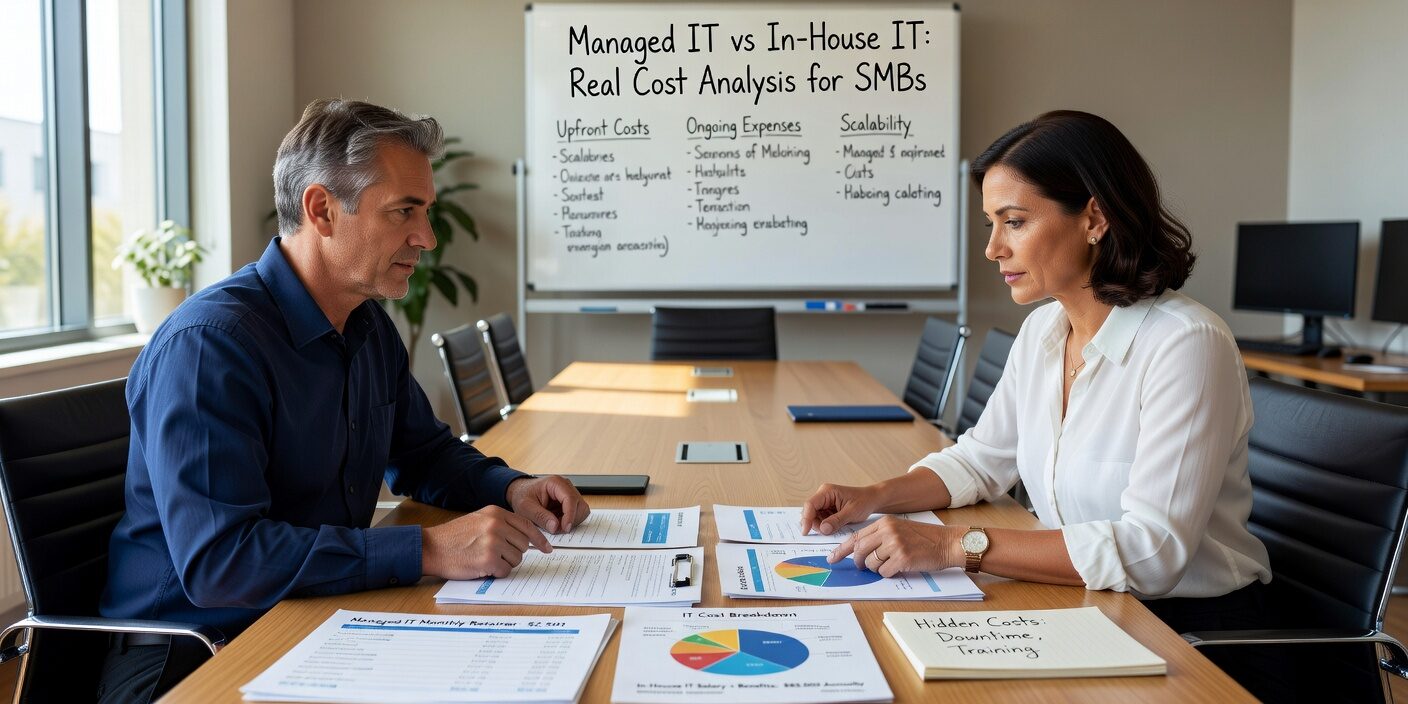
Making the decision between managed IT vs in house IT often comes down to understanding the true costs and operational efficiency each approach brings to your business. For small and medium businesses, this choice affects everything from monthly budgets to how quickly your team gets IT support when systems go down.
The reality is that most businesses underestimate their total IT spending by 30-40% when they try to handle everything internally. Hidden costs like staff benefits, training, after-hours coverage, and unplanned downtime add up faster than expected.
Breaking Down the Real Costs
When comparing managed IT vs in house IT, you need to look beyond base salaries. Here’s what each approach actually costs for a typical 15-30 person business:
In-House IT Costs:
- IT staff salary: $65,000-$95,000
- Benefits and taxes (30% overhead): $19,500-$28,500
- Training and certifications: $3,000-$8,000
- Software licenses and tools: $5,000-$12,000
- After-hours coverage gaps: $8,000-$15,000
- Total annual cost: $100,500-$158,500
Managed IT Service Costs:
- Monthly service fees: $100-$200 per user
- All tools, monitoring, and support included
- 24/7 coverage included
- Total annual cost for 15-30 users: $18,000-$72,000
This means many businesses save $20,000-$80,000 annually by choosing managed services over hiring internal staff.
Efficiency and Scalability Differences
Speed of Problem Resolution
Managed IT providers typically resolve issues faster because they have specialized teams available around the clock. When your email server crashes at 7 PM on Friday, managed IT support can address it immediately. An in-house employee might not be available until Monday morning.
Access to Expertise
A single IT employee, no matter how skilled, cannot match the combined knowledge of an entire managed IT team. Providers employ specialists in:
- Network security
- Cloud migrations
- Backup and recovery
- Compliance requirements
- Vendor management
Scalability Challenges
Growing businesses face a critical decision point. When you outgrow one IT person, do you hire a second at $100,000+ per year? Or do you scale gradually with managed services that charge per user?
Managed services scale smoothly – add five new employees, and your monthly cost increases proportionally. Hiring requires months of recruiting, training, and potentially overpaying for skills you only need occasionally.
Hidden Costs That Tip the Scale
Downtime Expenses
The average cost of IT downtime for small businesses ranges from $137 to $427 per minute. In-house IT often operates reactively, fixing problems after they occur. Managed IT providers use proactive monitoring to prevent many issues before they cause downtime.
Staff Turnover Risk
When your single IT employee leaves, you face:
- Immediate coverage gaps
- Knowledge loss
- Recruiting and training costs ($15,000-$25,000)
- Potential security vulnerabilities during transition
Managed providers eliminate this single-point-of-failure risk.
Compliance and Security
Staying current with cybersecurity threats and compliance requirements demands constant attention. Managed IT providers include:
- Regular security assessments
- Patch management
- Backup testing
- Compliance documentation
For in-house IT, these tasks often get delayed due to daily firefighting.
When In-House IT Makes Sense
Despite the cost advantages of managed services, some situations favor internal IT teams:
- Large organizations (150+ employees) can justify multiple IT staff members
- Highly specialized systems that require constant on-site presence
- Strict data control requirements where external access isn’t acceptable
- Businesses with substantial IT budgets that want maximum customization
Co-Managed IT: The Middle Ground
Many growing businesses choose a hybrid approach:
- Keep one internal IT person for daily tasks and business-specific needs
- Partner with managed services for specialized expertise, after-hours support, and major projects
- Gain cost savings while maintaining internal knowledge
This approach works well for businesses transitioning from small to mid-size, typically those with 40-100 employees.
Making the Decision: Key Questions
Before choosing between managed IT vs in house IT, ask yourself:
- Can we afford $100,000+ annually for internal IT staff plus tools and training?
- Do we need 24/7 IT support for our business operations?
- How quickly do we need to scale our IT capabilities?
- What happens to our operations when our IT person takes vacation or leaves?
- Do we have the expertise to handle cybersecurity threats effectively?
Budget predictability often drives the decision. Managed IT services provide fixed monthly costs that scale with your business. In-house IT involves variable expenses that spike during emergencies, equipment purchases, or staff changes.
What This Means for Your Business
The managed IT vs in house IT decision ultimately depends on your business size, growth plans, and operational requirements. For most businesses with fewer than 100 employees, managed services deliver better value through lower costs, higher expertise, and improved efficiency.
The key is finding a provider that understands your business needs and can scale support as you grow. Look for transparent pricing, clearly defined response times, and experience with businesses similar to yours.
Ready to explore how managed IT support for growing businesses can reduce your costs while improving reliability? Contact TECHZN to discuss your specific requirements and get a customized cost comparison for your business.