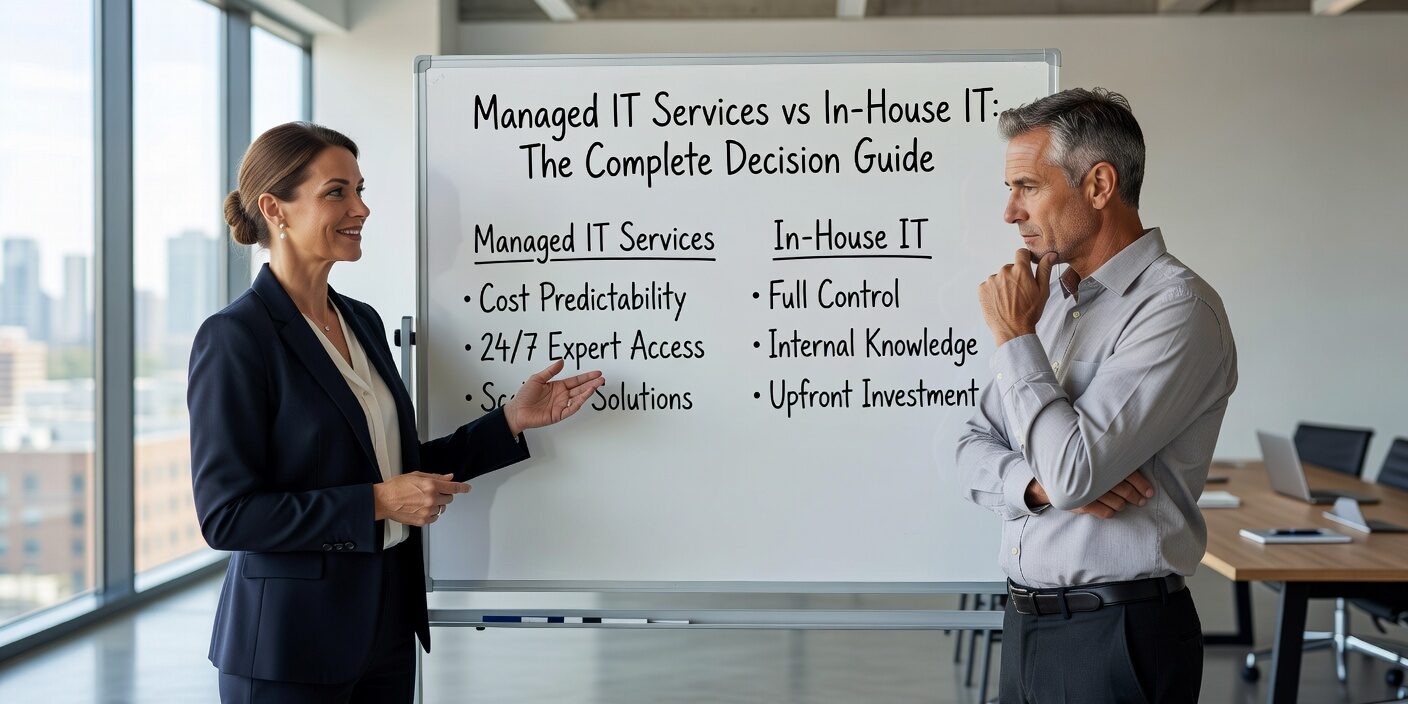
Making the right IT decision can determine whether your business operates smoothly or faces costly downtime. The choice between managed IT services vs in house IT affects everything from your monthly budget to your cybersecurity posture and response time during critical outages.
Many business owners underestimate the true cost of building an internal IT team. Beyond salaries, there are benefits, training costs, software licenses, hardware purchases, and the hidden expense of gaps in coverage when team members are unavailable.
Understanding the Real Cost Differences
The financial comparison between managed IT and in-house teams reveals significant differences that extend beyond simple salary calculations.
Managed IT Services Costs:
- Predictable monthly fees ranging from $100-$300 per user
- No recruitment, training, or benefits expenses
- Included software licenses and security tools
- 24/7 monitoring and support coverage
In-House IT Team Costs:
- Average IT technician salary: $55,000-$75,000 annually
- Benefits and overhead: Additional 30-40% of salary
- Software licenses: $5,000-$15,000 per year
- Training and certifications: $3,000-$8,000 annually
- Equipment and infrastructure: $10,000-$25,000 upfront
For a 30-employee business, managed services typically cost around $54,000 annually, while an in-house approach often exceeds $125,000 when all factors are included.
The hidden costs become apparent during emergencies, vacation coverage, and technology upgrades when internal staff may lack specialized expertise.
Expertise and Coverage Comparison
One critical factor in the managed IT services vs in house IT decision involves access to specialized knowledge and consistent coverage.
Managed IT Advantages
Broad Expertise: Managed service providers maintain teams of specialists covering cybersecurity, cloud services, network infrastructure, and compliance. A single in-house hire cannot match this breadth of knowledge.
Continuous Coverage: 24/7 monitoring means issues are detected and often resolved before they impact your business operations. After-hours emergencies receive immediate attention rather than waiting until the next business day.
Current Certifications: Managed service teams maintain up-to-date certifications across multiple technology platforms, staying current with security threats and best practices.
In-House IT Advantages
Deep Business Knowledge: Internal staff understand your specific workflows, applications, and business priorities in detail.
Physical Presence: On-site support for hands-on troubleshooting and immediate response to hardware issues.
Custom Solutions: Ability to develop highly customized systems and processes tailored to unique business requirements.
Scalability and Business Growth
Your choice between managed and in-house IT significantly impacts how easily your technology can grow with your business.
Managed Services Scaling: Adding new employees, locations, or services happens quickly through existing infrastructure. No lengthy hiring processes or training delays.
In-House Scaling Challenges: Growth requires additional hires, extended recruitment timelines, and potential gaps in coverage during transitions.
Most growing businesses find that managed services provide the flexibility needed during expansion phases, while maintaining consistent support quality.
Security and Compliance Considerations
Cybersecurity expertise represents one of the most significant differences in the managed vs in-house comparison.
Managed service providers invest heavily in security tools, threat intelligence, and specialized staff that most small businesses cannot afford independently. They implement enterprise-grade security measures across multiple clients, spreading costs and improving protection.
In-house teams may struggle to maintain current knowledge of evolving threats, security patches, and compliance requirements without dedicated security specialists.
Decision Framework for Your Business
Several key factors should guide your managed IT services vs in house IT decision:
Choose Managed IT Services If:
- Your business has fewer than 100 employees
- Predictable monthly costs are important for budgeting
- You need 24/7 monitoring and support
- Cybersecurity expertise is critical
- You’re planning rapid growth or expansion
- Current IT challenges interrupt core business activities
Consider In-House IT If:
- You have highly specialized or proprietary systems
- Immediate on-site presence is frequently required
- Your business operates in a unique environment with specific compliance needs
- You have the budget for multiple specialized IT professionals
- Technology is a core competitive advantage requiring custom development
Hybrid Approaches
Many businesses benefit from a co-managed approach that combines internal IT staff with managed IT support for growing businesses. This model provides on-site presence for day-to-day needs while leveraging external expertise for specialized projects, after-hours support, and advanced security.
Common Implementation Mistakes
Businesses often make these errors when choosing between managed and in-house IT:
Underestimating Total Costs: Focusing only on salary costs while ignoring benefits, training, tools, and coverage gaps.
Overestimating Internal Capabilities: Assuming one or two IT professionals can handle all technology needs, from basic support to advanced cybersecurity.
Ignoring Growth Planning: Choosing a solution that works today but cannot scale effectively with business expansion.
Neglecting Compliance Requirements: Failing to account for specialized knowledge needed for industry regulations and security standards.
What This Means for Your Business
The managed IT services vs in house IT decision affects your operational efficiency, security posture, and financial predictability. Most small to medium businesses find that managed services provide superior value through expert knowledge, 24/7 coverage, and predictable costs.
The key is honestly assessing your current IT challenges, growth plans, and budget constraints. Many businesses discover that what initially appears as a simple cost comparison actually involves complex factors around expertise, coverage, and scalability.
Successful businesses often start with a comprehensive IT assessment to understand their actual needs and costs before making this critical decision.
Ready to explore how managed IT services could benefit your business? Contact TECHZN for a free IT assessment and discover how professional IT support can reduce downtime, improve security, and provide the predictable technology foundation your business needs to grow.